.svg)
Automate the manual work that's limiting your test throughput
Quix automates the data pipeline around your tests, from ingestion and analysis through storage and reporting, so your time goes to engineering decisions, not file handling.

The problem:
Manual overhead is hard to fix with your current tools
You've probably tried to automate parts of your test workflow before. The reason it's difficult is that the tools weren't designed for it.
Your systems weren't designed to talk to each other
INCA, DIAdem, CANalyzer, LabVIEW: each tool has its own data format, its own export process, its own API (if it has one at all), and its own way of naming things. The reason you're shuttling data through Excel is that there's no common data layer connecting these systems. That's the gap Quix fills.
Post-processing is bolted on after the test
In a typical workflow, data is acquired during the test, exported after the test, cleaned separately, and then analysed in a different tool. Each of these steps is manual and sequential. Nothing runs in parallel, and nothing happens automatically when a test completes.
No feedback loop during execution
Your test executive runs the sequence. Your analysis tools process the results afterwards. There's no mechanism for analysis to inform the running test, which is why tests run to completion even when the answer was clear 30 minutes in, and why calibration uses static parameters instead of adjusting after each run.
Reporting is still a manual project
Generating a test report means pulling data from multiple sources, formatting it manually, cross-referencing configurations, and compiling the document. For complex campaigns, this alone can take weeks. There's no system that detects "test complete" and generates the report automatically.
Get our latest whitepaper:
'How to Load & Analyze Engineering Data Faster with Modern Software Principles'
Learn how high-performance engineering teams architect their test data for faster analysis, and apply the same patterns to your test cell.

What changes when the data overhead per test shrinks

Stop tests when you have the answer
When analysis runs live alongside the test, you can detect success or failure conditions as they happen. A test scheduled for two hours that produces a clear result in 30 minutes can be stopped at 30 minutes. That's rig time recovered for the next run, and over a full campaign, it compounds into days of capacity you didn't have before.
Reports waiting for you in the morning
Automated report generation means engineers start the day with results ready to review. The reports that used to take weeks of manual compilation for complex campaigns can be generated in minutes, consistently formatted, with the same metadata every time.
Monitor multiple rigs from one station
Build Python monitoring applications that watch multiple rigs in parallel, tracking 300+ channels continuously. Instead of one operator mentally tracking a single rig's data streams, the software handles threshold monitoring and anomaly detection across all rigs simultaneously. The operator makes decisions when something needs attention.
Dynamic parameters, fewer calibration runs
When your analysis runs live, you can calculate the next run's parameters automatically based on actual results instead of using static values. That's what turns a 5-run calibration process into a 2-run process, saving hours of rig time every cycle.
What automated test workflows look like with Quix
Connect your systems once, data flows automatically
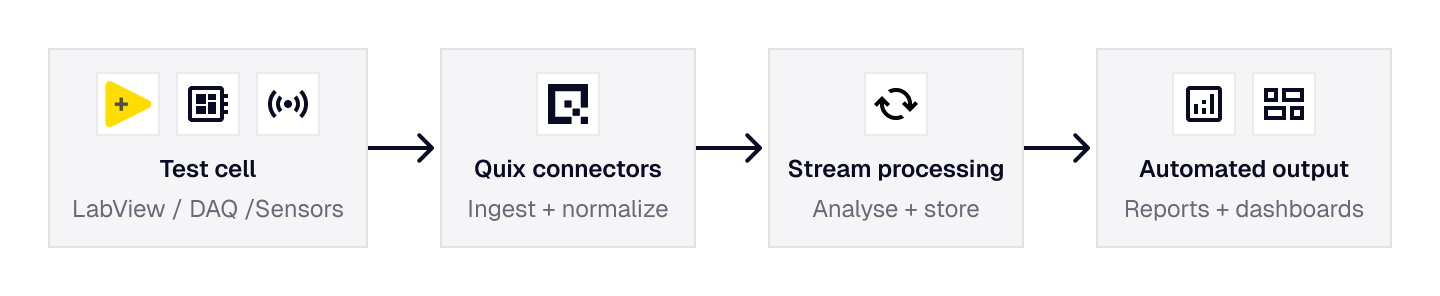
Quix provides pre-built connectors for MQTT, OPC-UA, InfluxDB, and LabVIEW, plus a Python framework for custom integrations. You wire up your data sources once. After that, every test run automatically ingests, normalises, tags with metadata, and stores the data. The export step and manual file handling disappear entirely.
Every test run linked to its full configuration
Quix captures the complete configuration state at the start of each run: software versions, rig hardware settings, environmental setpoints, instrument calibrations. That snapshot is stored as structured metadata attached to the time-series data. When you need to reproduce a result or understand why two runs differ, the configuration context is already there. No reconstructing what was running from memory or separate systems.
Processing runs in parallel with the test
Instead of waiting until after the test to process data, Quix runs your analysis logic against the live sensor feed. Data cleaning, unit conversion, derived channel calculation, and threshold monitoring all happen as data arrives. When the test ends, the processed data is already in the format you need.
Event-driven automation after each test
Quix detects when a test completes and can trigger downstream processes automatically: generate a standardised report, calculate parameters for the next run, update a dashboard, or send an alert. The sequence from "test complete" to "report ready" happens without human intervention.
Sits alongside your existing test cell infrastructure, doesn't replace it
Quix connects to your DAQ systems, test executives, and data acquisition hardware through standard industrial protocols. LabVIEW, TestStand, and your proprietary test control systems stay in place. Quix doesn't touch your control logic or certified sequences. It automates the data handling that happens around them. Your test cell setup stays the same; the manual pipeline around it disappears.
Trusted by data-intensive R&D teams at:





Low risk, fast time to value
Expert consulting included
Many engineering teams don't have software expertise in-house, which is why Quix includes hands-on technical consulting to get you up and running. We can also run workshops to show your engineers how to build their own data tools.
Get a working pilot in days
You don't need a 6-month business case. Get a pilot running with a small representative dataset. Show stakeholders a live demo with real query times instead of a slide deck.
Runs on your infrastructure
Quix deploys on-premise or in your own VPC. No data ever leaves your network. Once deployed, Quix operates without any connection to the outside world, which is why teams in defence, aerospace, and other regulated industries trust it.
No vendor lock-in
Quix runs on open-source technologies: Kafka, Kubernetes, standard time-series databases. If you ever need to walk away, you keep the blueprint, the code, and the skills.