Manufacturing
Cutting product testing time by 90% at a leading European HVAC manufacturer
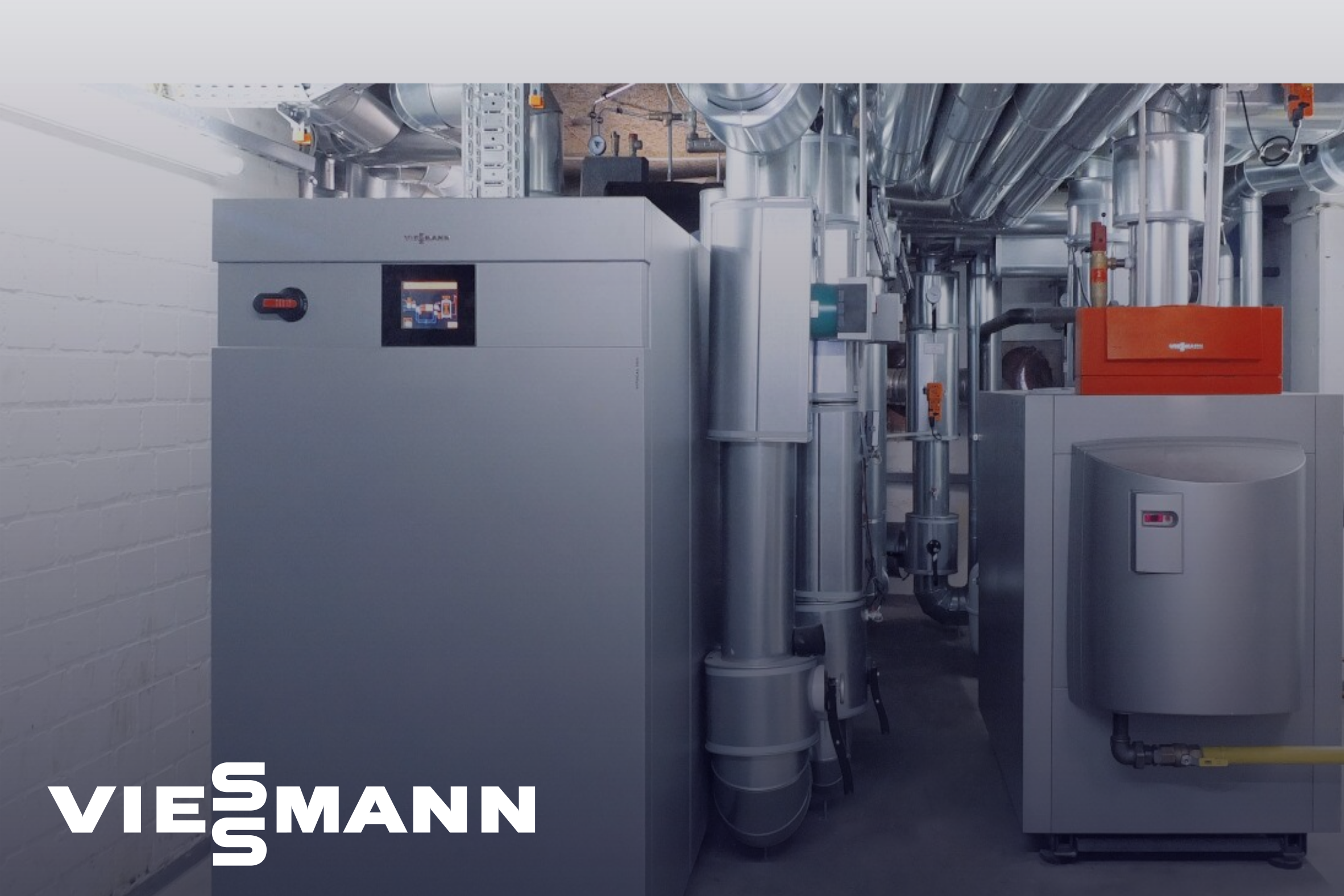
How a premium heating and cooling manufacturer empowered its R&D engineers to build their own test data infrastructure with Quix after struggling to build their own infrastructure and find vendors flexible enough to match their needs.
.avif)
Up to 90%
Targeted reduction in testing time
40+
Test chambers connected to a centralized data platform
1 day
Engineers building on the platform from their first day
A leading European HVAC manufacturer was under pressure to accelerate product development. As Europe moves to ban the sale of gas-fired boilers, the company must rapidly develop new heat pump technologies while maintaining market-leading performance, before foreign competitors flood the market.
As a premium brand with smaller production volumes, the company's R&D costs are spread across fewer units. Every inefficiency in development directly inflates the product price. It could not afford to fall behind, but neither could it simply hire hundreds more engineers. It needed to digitalize engineering processes to do more with its existing team.
This became the key objective of the Advanced Engineering department: to develop, test and iterate faster. However, it had been difficult for them to find the right approach to modernize their data infrastructure. After some trial and error, they eventually turned to Quix to build a centralized data platform that their own engineers could operate without needing to expand the team with dedicated software developers.
The opportunity
A long search for the right platform
The company's Director of Advanced Engineering was brought in to help digitalize and automate testing and simulation workflows using modern data management techniques. He developed an internal strategy and evaluated multiple approaches. Finding the right fit took time.
Large enterprise platforms were too rigid. The team evaluated solutions from traditional industrial software providers. These platforms required the company to restructure internal processes to fit the vendor's ecosystem. Customization projects grew in cost and timeline, and the level of investment required to tailor them to the company's specific workflows made them impractical.
"We worked with a lot of vendors, but everything turned out to be very difficult until we found your solution."
Director of Advanced Engineering
Internal resources were stretched thin. Like many large organizations, the company's central IT function was focused on enterprise-wide priorities that did not always align with the R&D team's pace and requirements. The Advanced Engineering team needed more autonomy to move quickly, which meant finding a platform they could operate independently.
Building a custom solution with open-source tools was too complex. The team also tried to create a bespoke data pipeline without help from IT using open-source technologies such as FIWARE , RedPanda, and Docker running on VMs. However this solution was very brittle and difficult to maintain. It also meant that Systems engineers were moonlighting as software developers which was stealing time from their principal responsibilities.
Complex data infrastructure with limited software engineering resources
The Advanced Engineering team operates over 40 test chambers across multiple locations, each one a complex ecosystem of data sources. A single test chamber generates data from the hardware under test (heat pump controllers, compressors, heat exchangers), from the climate chamber's own environmental controls, and from dozens of additional sensors and probes installed throughout the system.
Their model-based development workflow is equally complex. Engineers develop 1D system models in Modelica (exported as FMUs) and controller models in MATLAB/Simulink. They run CFD simulations in ANSYS, STAR-CCM+, and OpenFOAM. They need to compare simulation outputs with live test data, feed live sensor readings as boundary conditions into running simulations, and manage the metadata and configuration for every experiment.
The core challenge: the engineers who understood the R&D processes intimately were mechanical engineers and thermodynamicists, not software developers. They knew exactly what they needed to build, but time and know-how to build it themselves. And when they worked with external vendors to develop custom solutions, the vendors struggled to keep pace with the engineering team's fast-evolving requirements.
Additionally, Senior leadership had set an ambitious aspiration: dramatically reduce testing time by as much as 90%. Today, a single tester typically manages a single test rig, manually overseeing experiments and analyzing results. The long-term vision is to have one tester overseeing multiple test rigs simultaneously, with automated analysis running in real time. Automated analysis would enable them to stop tests early when results are conclusive, flagging issues before they waste hours of chamber time, and automatically adjusting set points based on live model comparisons.
Achieving any of this required solving several interrelated problems:
Fragmented, manual data workflows. Test data lived in scattered InfluxDB instances, CSVs, and proprietary formats. Configuration metadata such as sensor mappings, scenario definitions, and test parameters was spread across network drives in JSON files, INI files, and spreadsheets. Engineers spent significant time simply moving and reformatting data between systems before they could begin any analysis.
No connection between simulation tools and live data. MATLAB and Simulink, where all controller development happened, could not easily receive live test data or push results back to the central data store. The same was true for Modelica models and CFD tools. Each integration required bespoke scripts that engineers usually needed to run manually.
Slow, manual model deployment. Releasing a new version of a simulation model required engineers to manually clone repositories, adapt to changes in bus structures that bundle multiple signals or parameters together, and rerun simulations. This made the deployment process slow and error-prone, and automated regression testing was difficult to implement because controller updates could break interfaces.
No real-time analysis capability. Without automated, real-time analysis of test results, engineers could not stop tests early, detect errors during execution, or make data-driven decisions about what to test next. Tests ran to completion on fixed schedules whether the answer had been obtained in the first 30 minutes or not.
The engineers who understood these problems best were systems engineers and thermodynamicists. They had the domain knowledge to design the solutions, but not the software infrastructure to build and deploy them at scale. What the team needed was a platform that closed that gap.
"We need to have something which gives engineers the tool set to build solutions on their own. They know what they want and they know how the steps would look like. But they are not software developers and they are not software architects."
Director of Advanced Engineering
The solution
A self-service data platform enabling engineers to build
The team chose Quix because it offered something no other vendor could: a platform that empowered tech-savvy systems engineers to build production-grade data infrastructure themselves, without requiring deep software engineering expertise.
Quix provided the company with a Python-first environment that felt immediately familiar. The team's existing tooling was already heavily Python-based, so the transition was natural.
With Quix, the team is building a centralized data and simulation infrastructure that will eventually connect all 40+ test chambers to a single internal platform. The architecture addresses each of the challenges they faced:
Centralized data pipeline replacing fragmented scripts. Quix serves as the backbone for all test data, replacing the collection of bespoke scripts and manual file transfers. Data from MQTT brokers, PLCs, and test bench controllers flows through Quix processing services (each one a containerized Python application with dedicated system resources). Raw time-series data is normalized, time-aligned, and tagged with configuration metadata before being persisted to InfluxDB and MongoDB.
Standardized integration with simulation tools. The platform provides a standardized way to connect MATLAB, Simulink, Modelica FMUs, and CFD tools to live and historical test data. Engineers can feed live sensor channels from a climate-chamber rig into an FMU at each time step, allowing the model to run in parallel with the physical test and flag deviations in real time. The same infrastructure handles packing and normalizing data sets for CFD boundary conditions—a process that previously consumed as much time as the simulation itself.
Real-time analysis and automated testing workflows. With processing services analyzing results as data arrives, the team is working toward automated test management. The vision: a service inside Quix monitors test progress, determines whether success criteria have been met, and either stops the test early or adjusts set points for the next phase with minimal human intervention.
Built-in CI/CD for rapid model deployment. Quix's Git-based workflow and container infrastructure gives engineers a path from code to deployment that previously did not exist. New model versions, analysis scripts, and processing services can be deployed without the fragile manual process of cloning, editing, and rerunning.
A team upskilled with the help of Quix expertise and AI-assisted coding
The technical architecture solved the infrastructure problems, but two other factors proved just as important in making the project succeed.
AI-assisted development for non-software engineers. The Quix platform’s integrated AI coding assistance and Claude Code Skills was a revelation and helped the team build all kinds of custom Quix plug-ins in a few hours (a task that would have normally taken days). The Director noted that AI-assisted coding combined with Quix's CI/CD pipeline means that "even a mechanical engineer is able to do a lot more complex tasks in terms of software. It's so easy…just type 'please push it to Quix' and that's it."
A hands-on partnership. Critically, the Quix team worked alongside the company's engineers throughout the process, running workshops, pair-programming on early services, and helping the team build confidence with the platform rather than building solutions for them. The project lead described this as "much more support than with the usual cooperation with a supplier or a partner." This collaborative approach was deliberate: the goal was always to transfer capability to the engineering team, not to create a dependency on external consultants. By year's end, engineers at one site were fully self-sufficient on the platform and onboarding colleagues at other locations without Quix involvement.
"We would never have been so far without your support and without the platform. It already accelerates the way of working."
Director of Advanced Engineering
The outcome
Engineers automating test workflows autonomously
Quix has a significant impact on the way the engineering team works:
Immediate engineer adoption. Unlike previous vendor solutions that required top-down mandates and lengthy training periods, engineers started building on Quix from the first day. The Python-native environment and AI-assisted coding tools eliminated the learning curve that had stalled earlier initiatives. Team members began adding data processing services, analysis tools, and integrations on their own initiative, without waiting for management direction.
A credible path to dramatic testing time reduction. The combination of real-time analysis, automated test management, and model-driven experiment design gives the team a realistic roadmap to meeting leadership's ambitious goals. By running Design of Experiments iteratively ( testing at specific points, refining models based on results, and automatically proceeding to the next test) they can eliminate redundant test runs and stop successful tests early. Increasing the tester-to-rig ratio is now an engineering problem, not an infrastructure problem.
Greater autonomy for the R&D team. The self-service model means the team can move at its own pace, building what they need without depending on external system integrators or waiting for central IT resources. The platform handles the infrastructure complexity, so engineers stay focused on engineering.
Evangelizing Quix to other internal teams. Perhaps the clearest sign of success is how the team now talks about the project. The team is actively championing the platform to other departments within the company—not because they were asked to, but because they believe in the approach.
"From our perspective as developers managing this project, we think this is the best way of cooperation we have had. Asking somebody else—a vendor—to build something for us was difficult and brought us a lot of obstacles."
Director of Advanced Engineering
Looking ahead
The team's roadmap includes expanding automated testing across all test chambers, deepening the integration with MATLAB and Simulink for controller-in-the-loop testing, and exploring AI-driven experiment optimization. The Director anticipates that within three years, software will no longer be a bottleneck in R&D. The focus will shift back to the mechanical and thermodynamic challenges that are harder to automate. Quix is the platform enabling that transition.
What’s a Rich Text element?
The rich text element allows you to create and format headings, paragraphs, blockquotes, images, and video all in one place instead of having to add and format them individually. Just double-click and easily create content.
Static and dynamic content editing
A rich text element can be used with static or dynamic content. For static content, just drop it into any page and begin editing. For dynamic content, add a rich text field to any collection and then connect a rich text element to that field in the settings panel. Voila!
“Moving data around is also not easy. Now we collect up to 400 GB of compressed Influx files per day on the biggest plants. Moving that around with scripts was out of the question.”
How to customize formatting for each rich text
Headings, paragraphs, blockquotes, figures, images, and figure captions can all be styled after a class is added to the rich text element using the "When inside of" nested selector system.
Discuss your use case
Talk with our team of experts to learn more about how companies are accelerating their product development with Quix.


.jpg)