Understanding Ingestion Rate Fundamentals
Industrial data systems must accommodate varying ingestion rates based on operational demands, sensor populations, and process criticality. Manufacturing facilities may generate millions of data points per second during peak production periods, requiring systems capable of sustained high-throughput operations.
The ingestion rate directly impacts system responsiveness, storage efficiency, and the ability to maintain real-time visibility into industrial processes. Insufficient ingestion capacity can lead to data loss, increased ingestion latency, and degraded system performance during critical operational periods.
Core Performance Factors
Several key factors influence achievable ingestion rates in industrial environments:
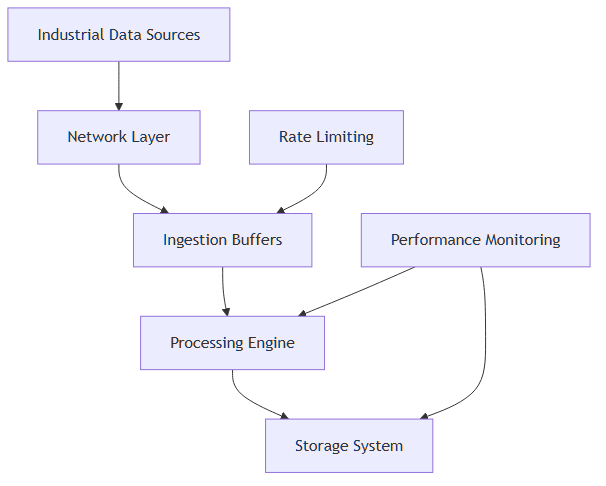
Applications in Industrial Data Processing
High-Volume Sensor Networks
Manufacturing environments with thousands of sensors require systems capable of ingesting millions of measurements per second. Effective rate management ensures comprehensive monitoring without data loss during peak production periods.
Process Control Systems
Industrial process control generates continuous data streams from control loops, safety systems, and operational interfaces. Sustained ingestion rates enable real-time process visibility and responsive control system operation.
Equipment Monitoring
Condition monitoring systems collect high-frequency vibration data, temperature measurements, and operational parameters. Consistent ingestion rates support predictive maintenance algorithms and equipment health analysis.
Performance Optimization Strategies
Batch Processing Optimization
Grouping incoming data into appropriately sized batches reduces per-record overhead while maintaining acceptable latency. Industrial systems typically optimize batch sizes based on data volume patterns and processing requirements.
Buffer Management
Strategic buffer allocation and management enable systems to handle temporary spikes in data volume while maintaining steady-state performance. Buffer sizing must balance memory utilization with processing efficiency.
Parallel Processing
Distributed ingestion architectures leverage multiple processing threads and storage partitions to achieve higher aggregate throughput rates while maintaining system reliability.
Measurement and Monitoring
Implementation Best Practices
# Example rate monitoring configuration
rate_config = {
    "measurement": {
        "interval": "1s",
        "metrics": ["records_per_second", "bytes_per_second", "errors_per_second"]
    },
    "thresholds": {
        "warning": "80% of capacity",
        "critical": "95% of capacity"
    },
    "optimization": {
        "batch_size": "adaptive",
        "buffer_allocation": "dynamic"
    }
}
Scaling Strategies
Related Concepts
Ingestion rate optimization intersects with data streaming performance, ingestion pipelines design, and industrial data historians capacity planning. Understanding these relationships enables comprehensive system design that balances throughput, latency, and reliability requirements.
Effective ingestion rate management represents a critical capability for industrial data systems, enabling organizations to capture comprehensive operational data while maintaining system performance and reliability under varying operational conditions and data volume demands.