Understanding IIoT Data Fundamentals
Industrial IoT data emerges from the convergence of operational technology (OT) with information technology (IT), creating interconnected networks of smart sensors, actuators, and control systems that continuously monitor and control industrial processes. Unlike traditional industrial data collection methods, IIoT data is characterized by its velocity, volume, and variety—often generating terabytes of information daily from thousands of connected devices across manufacturing facilities.
The fundamental value of IIoT data lies in its ability to provide real-time visibility into every aspect of industrial operations, enabling Model Based Design approaches and supporting data-driven decision making that optimizes efficiency, quality, and safety across industrial operations.
Core Components and Data Architecture
IIoT data ecosystems comprise multiple layers working together to collect, process, and analyze industrial information:
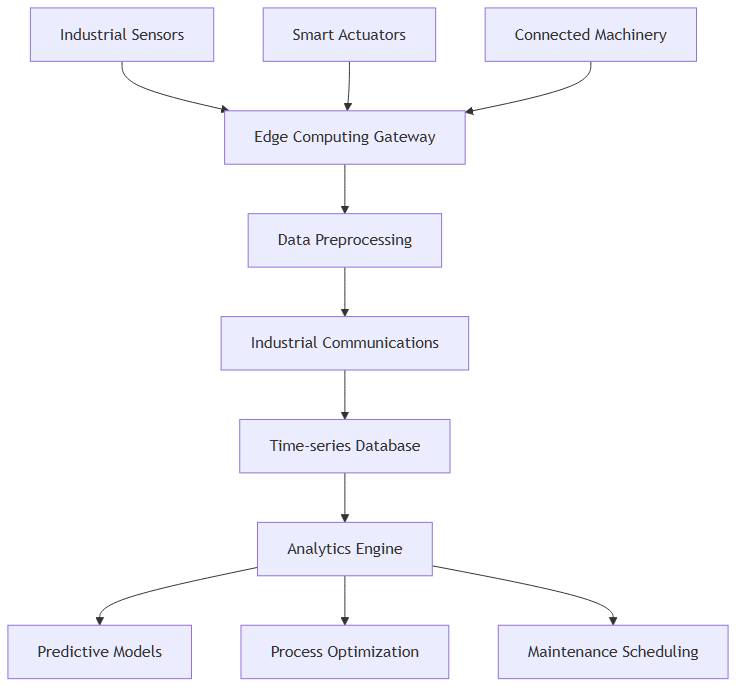
Applications in Industrial Operations
Predictive Maintenance
IIoT data enables condition-based maintenance strategies by continuously monitoring equipment health through vibration analysis, thermal imaging, and oil condition monitoring. Machine learning algorithms analyze patterns to predict failures before they occur, reducing unplanned downtime and maintenance costs.
Process Optimization
Manufacturing processes benefit from IIoT data through real-time monitoring of key performance indicators, energy consumption patterns, and quality metrics. This data supports continuous improvement initiatives and enables adaptive control systems that optimize operations automatically.
Supply Chain Visibility
IIoT data provides end-to-end visibility into supply chain operations, tracking raw materials, work-in-progress inventory, and finished goods through RFID tags, smart sensors, and automated identification systems.
Safety and Environmental Monitoring
Industrial facilities utilize IIoT data for continuous monitoring of environmental conditions, gas concentrations, and safety parameters, enabling immediate responses to hazardous conditions and ensuring regulatory compliance.
Data Management and Processing Strategies
Edge Processing: Strategic placement of computing resources at the edge of industrial networks enables real-time processing, reduces bandwidth requirements, and ensures low-latency responses for critical control applications.
Data Quality Management: Implementing data validation, cleansing, and normalization processes ensures reliable analytics results and maintains data integrity across distributed IIoT systems.
Storage Optimization: Hierarchical storage management strategies balance performance requirements with cost considerations, using high-speed storage for recent data and cost-effective archival systems for historical information.
Technical Challenges and Solutions
Scalability Management: IIoT systems must handle exponential growth in connected devices and data volumes while maintaining performance and reliability standards.
Interoperability: Diverse industrial protocols and legacy systems require integration platforms that bridge traditional industrial networks with modern IoT technologies.
Security Frameworks: Industrial cybersecurity measures protect critical infrastructure from threats while enabling secure data sharing and remote monitoring capabilities.
Best Practices for IIoT Implementation
Implementation Considerations
# Example IIoT data configuration
iiot_config:
  sensors:
    - type: temperature
      location: reactor_001
      sampling_rate: 1000ms
      protocol: modbus_tcp
    - type: vibration
      location: pump_002
      sampling_rate: 100ms
      protocol: opc_ua
  edge_processing:
    filters: [noise_reduction, outlier_detection]
    aggregation: 1min_average
    local_storage: 24h
Emerging Technologies and Trends
5G Industrial Networks: Ultra-low latency and high bandwidth 5G networks enable new IIoT applications requiring real-time communication and massive device connectivity.
AI and Machine Learning Integration: Advanced analytics capabilities transform raw IIoT data into actionable insights through pattern recognition, anomaly detection, and predictive modeling.
Digital Twin Evolution: IIoT data feeds sophisticated digital twin models that simulate and optimize industrial processes in virtual environments.
Related Concepts
Industrial IoT data management intersects closely with sensor data processing, telemetry data systems, and Industrial Data Historian platforms. Understanding these relationships is essential for designing comprehensive industrial data architectures.
Industrial IoT data represents the cornerstone of modern smart manufacturing, enabling unprecedented visibility into industrial operations and supporting the advanced analytics capabilities necessary for competitive manufacturing in the digital age.