Understanding Ingestion Pipeline Fundamentals
Industrial ingestion pipelines manage the complex task of transforming raw sensor data, equipment telemetry, and process measurements into structured, queryable formats. These systems handle data validation, format standardization, quality assurance, and efficient storage operations while maintaining data integrity and system performance.
The pipeline architecture ensures reliable data flow even under challenging industrial conditions, including network interruptions, equipment failures, and varying data volumes. Effective pipeline design enables seamless integration of heterogeneous data sources while providing scalability and fault tolerance.
Core Pipeline Components
Industrial ingestion pipelines comprise several interconnected stages that work together to ensure reliable data processing:
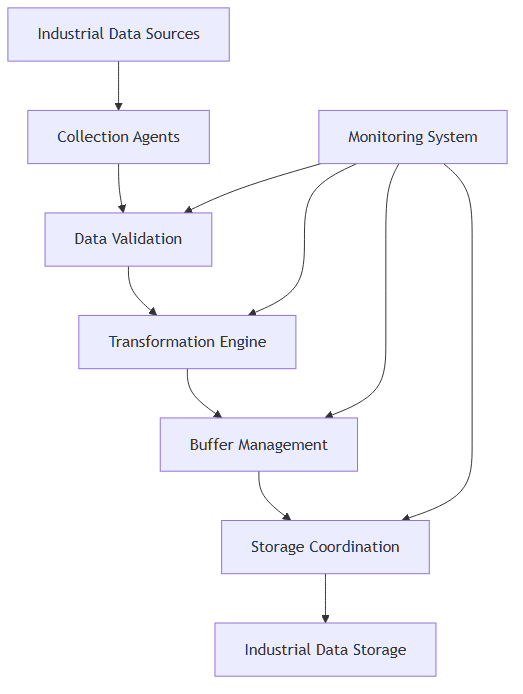
Applications in Industrial Data Processing
Manufacturing Process Monitoring
Industrial manufacturing pipelines collect data from multiple production lines, quality control systems, and environmental sensors. The pipeline aggregates this data to provide comprehensive production visibility and enable process optimization initiatives.
Equipment Health Management
Predictive maintenance systems rely on robust ingestion pipelines to collect vibration data, temperature measurements, and operational parameters from industrial equipment. These pipelines ensure continuous data availability for condition monitoring algorithms.
Energy Management Systems
Industrial energy management requires coordinated data collection from power meters, environmental controls, and production equipment. Ingestion pipelines correlate energy consumption with production output to identify optimization opportunities.
Pipeline Architecture Patterns
Batch Processing Pipelines
Batch-oriented pipelines process data in discrete time windows, typically suited for historical analysis, reporting, and non-critical monitoring applications. These pipelines optimize for throughput and resource efficiency.
Stream Processing Pipelines
Real-time stream processing pipelines handle continuous data flows with minimal latency, essential for process control, safety systems, and immediate alerting requirements. These architectures prioritize responsiveness and availability.
Hybrid Architectures
Many industrial environments employ hybrid approaches that combine batch and streaming patterns based on data criticality and processing requirements, optimizing both real-time responsiveness and analytical depth.
Performance Optimization Strategies
Implementation Best Practices
# Example pipeline configuration for industrial data
pipeline_config = {
    "sources": {
        "sensors": {"protocol": "MQTT", "qos": 1},
        "plc_data": {"protocol": "OPC-UA", "security": "certificate"}
    },
    "processing": {
        "validation": {"enable_outlier_detection": True},
        "transformation": {"auto_unit_conversion": True},
        "buffering": {"max_size": "100MB", "flush_interval": "5s"}
    },
    "outputs": {
        "historian": {"batch_size": 1000, "compression": "lz4"},
        "analytics": {"format": "parquet", "partitioning": "hourly"}
    }
}
Monitoring and Reliability
Industrial ingestion pipelines require comprehensive monitoring to ensure continuous operation:
Related Concepts
Ingestion pipelines integrate closely with data streaming architectures, industrial data historians, and time-series analysis systems. Understanding these relationships enables comprehensive data architecture design that supports both operational and analytical requirements.
Effective ingestion pipeline design represents a critical foundation for industrial data systems, enabling reliable data collection, processing, and storage while providing the flexibility and scalability needed to support evolving industrial automation and analytics requirements.