Summary
Data Sharding is a database architecture strategy that horizontally partitions large industrial datasets across multiple independent database instances to distribute computational load, improve scalability, and enhance performance for high-volume manufacturing and R&D data processing. In industrial environments, sharding enables organizations to manage massive volumes of sensor data, production records, and simulation results by dividing them across multiple database nodes based on logical criteria such as time ranges, equipment identifiers, or production lines. This approach is essential for supporting real-time analytics at scale, enabling efficient time-series analysis across distributed datasets, and maintaining optimal performance for predictive maintenance applications that require rapid access to historical data patterns.
Core Sharding Architecture
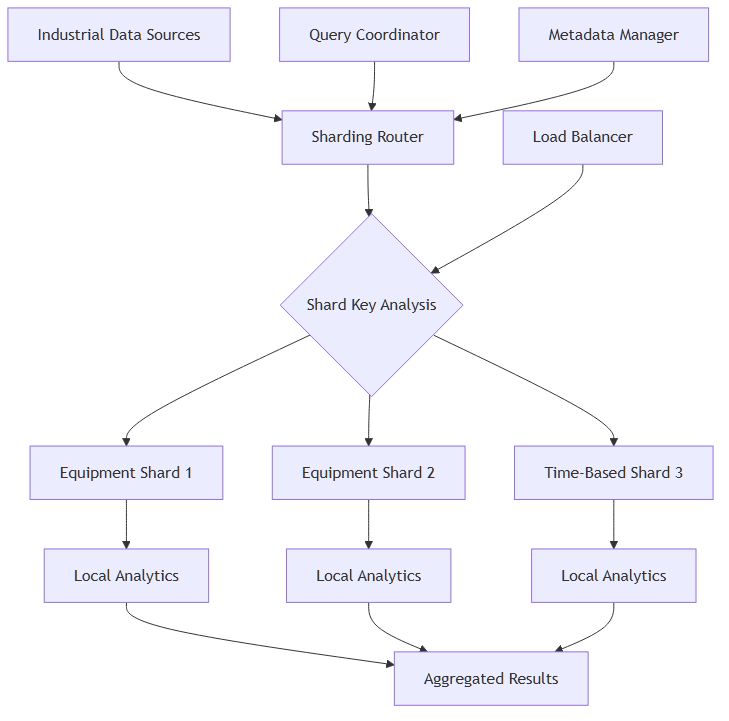
Industrial data sharding systems implement several key architectural components to manage distributed data effectively:
Applications and Use Cases
Manufacturing Operations
Large-scale manufacturing facilities use sharding to distribute production data across multiple database instances, with each shard handling data from specific production lines, equipment groups, or time periods. This approach enables parallel processing of quality analysis, production optimization, and equipment monitoring across different manufacturing areas.
Industrial R&D
Research environments benefit from sharding by organizing experimental data and simulation results across distributed systems, allowing research teams to work independently on different aspects of complex projects while maintaining access to comprehensive datasets for cross-domain analysis.
Multi-Site Operations
Organizations with multiple manufacturing or research facilities use geographic sharding to maintain local data processing capabilities while supporting enterprise-wide analytics and reporting requirements.
Shard Key Selection Strategies
Effective sharding in industrial environments requires careful selection of shard keys based on data access patterns and operational requirements:
Performance Benefits
Data sharding provides several critical performance advantages for industrial data systems:
Implementation Considerations
Deploying sharded database systems in industrial environments requires careful planning and consideration of several factors:
High Availability and Reliability
Sharded systems enhance reliability and availability through several mechanisms:
- Independent Operation - Each shard operates independently, preventing single points of failure from affecting the entire system
- Geographic Distribution - Shards can be distributed across different physical locations for disaster recovery
- Redundancy Options - Individual shards can be replicated for additional fault tolerance
- Graceful Degradation - System continues operating even when individual shards are temporarily unavailable
Related Concepts
Data sharding works closely with data partitioning strategies for logical data organization, data orchestration platforms for managing distributed operations, and industrial data collection systems for efficient data distribution. It also integrates with data retention policies for lifecycle management across shards and supports data provenance tracking in distributed environments.
Successful implementation of data sharding enables industrial organizations to scale their data management capabilities while maintaining high performance and reliability, supporting increasingly sophisticated analytics and operational intelligence requirements across large-scale manufacturing and research operations.