Core Components of Provenance Tracking
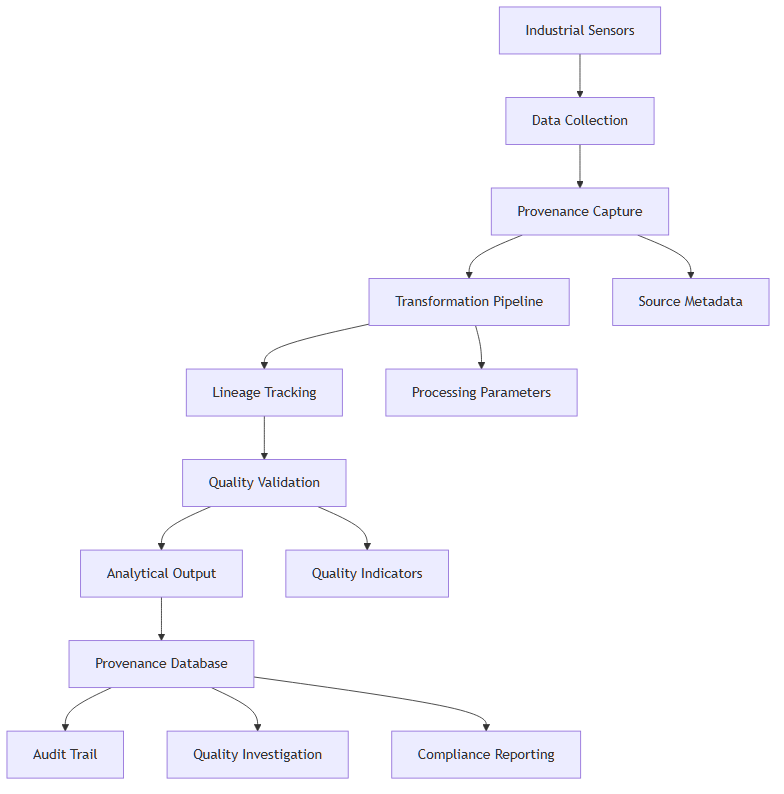
Industrial data provenance systems capture several types of critical information throughout the data lifecycle:
Applications and Use Cases
Quality Control and Investigation
When quality issues arise in manufacturing processes, data provenance enables engineers to trace defective products back through the entire production chain, identifying which sensors, processes, and time periods contributed to the problem. This capability accelerates root cause analysis and supports corrective action implementation.
Regulatory Compliance
Industries with strict regulatory requirements use data provenance to demonstrate data integrity and traceability for audit purposes. The complete audit trail supports compliance with industry standards and regulatory frameworks that require detailed documentation of data handling processes.
Model Validation and Verification
In R&D environments, data provenance supports model validation by providing complete documentation of the data used to train and test predictive models. This transparency is crucial for ensuring model reliability and supporting scientific reproducibility.
Implementation Strategies
Effective data provenance implementation in industrial environments requires consideration of several key strategies:
Performance and Storage Considerations
Data provenance systems must balance comprehensive tracking with practical performance requirements:
- Storage Overhead - Provenance metadata can significantly increase storage requirements
- Processing Impact - Real-time provenance capture must not interfere with operational systems
- Query Performance - Lineage queries must execute efficiently even with extensive historical data
- Retention Policies - Implement appropriate data retention policies for provenance information
Best Practices for Industrial Environments
Successful data provenance implementation in industrial settings follows several best practices:
Related Concepts
Data provenance integrates closely with data orchestration platforms for tracking data flow automation, time-series analysis for temporal lineage tracking, and data partitioning strategies for efficient provenance data organization. It also connects with data serialization techniques for preserving provenance metadata and industrial data collection systems for comprehensive data tracking.
Data provenance serves as the foundation for trustworthy industrial analytics, enabling organizations to maintain confidence in their data-driven decisions while meeting increasingly stringent requirements for data transparency, quality assurance, and regulatory compliance in modern manufacturing and R&D environments.