Summary
Data Partitioning Strategies are systematic approaches to dividing large industrial datasets into smaller, more manageable segments to optimize storage, retrieval, and processing operations in manufacturing and R&D environments. These strategies are essential for handling massive volumes of sensor data, simulation results, and operational metrics that characterize modern industrial systems. Effective partitioning directly impacts query performance, enables efficient time-series analysis, and supports scalable real-time analytics by ensuring that analytical operations can focus on relevant data subsets while maintaining optimal system performance for predictive maintenance and process optimization applications.
Core Partitioning Approaches
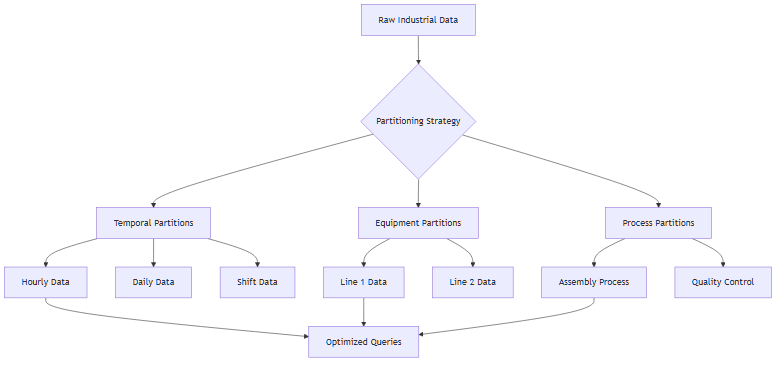
Industrial data partitioning strategies typically employ several fundamental approaches, often in combination:
Applications and Use Cases
Manufacturing Operations
Partitioning strategies enable efficient analysis of production data by organizing information according to manufacturing schedules, equipment groups, and product families. This organization supports rapid identification of quality issues, equipment performance trends, and production bottlenecks.
Industrial R&D
Research environments benefit from partitioning strategies that organize experimental data by test campaign, equipment configuration, and measurement type. This structure facilitates comparative analysis across different experimental conditions and accelerates hypothesis testing.
Process Control Systems
Real-time control systems use partitioning to maintain responsive access to current operational data while archiving historical information for trend analysis and model validation.
Performance Optimization Benefits
Effective data partitioning provides several critical performance advantages for industrial applications:
Implementation Considerations
When designing partitioning strategies for industrial environments, several factors must be carefully considered:
Advanced Partitioning Techniques
Modern industrial data systems employ sophisticated partitioning approaches:
Related Concepts
Data partitioning strategies work closely with data retention policies for lifecycle management, data compression techniques for storage optimization, and industrial data collection systems for efficient data organization. They also support data orchestration platforms and integrate with data provenance tracking systems for comprehensive data management.
Successful implementation of data partitioning strategies forms the foundation for scalable industrial analytics, enabling organizations to maintain high performance as data volumes grow while supporting increasingly sophisticated analytical requirements for manufacturing intelligence and operational optimization.