Understanding Ingestion Buffer Fundamentals
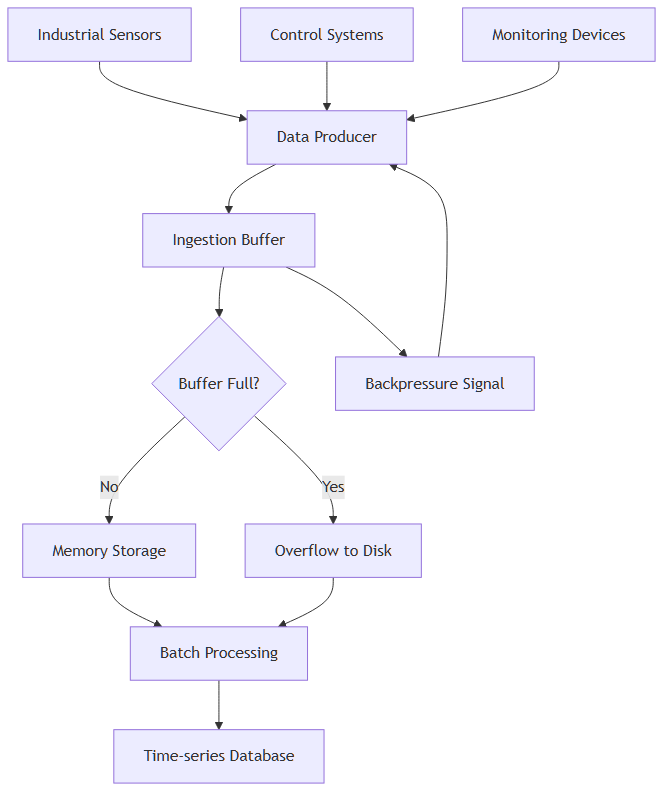
Ingestion buffers address the fundamental challenge of mismatched data production and consumption rates in industrial systems where sensor networks, control systems, and monitoring devices generate data at irregular intervals and varying volumes. Without proper buffering, systems can experience data loss during peak periods or suffer performance degradation when storage systems cannot keep pace with incoming data streams.
The core principle involves creating a resilient intermediate layer that decouples data producers from storage systems, enabling optimization of both ingestion patterns and storage performance while maintaining data integrity and system reliability in demanding industrial environments.
Core Components and Architecture
Ingestion buffers incorporate several essential components to manage data flow effectively:
Applications in Industrial Data Processing
Manufacturing Process Monitoring
Industrial manufacturing generates variable data loads as production schedules change, equipment cycles through different modes, and quality testing systems contribute periodic data bursts. Ingestion buffers smooth these variations while ensuring no critical process data is lost.
Equipment Health Monitoring
Condition monitoring systems produce irregular data patterns as they detect anomalies, perform detailed analyses, or respond to triggered events. Buffers enable these systems to handle diagnostic data bursts without impacting normal operations.
Quality Control Systems
Automated inspection and testing systems generate data in bursts corresponding to production batches or inspection cycles. Ingestion buffers ensure quality data is captured reliably while optimizing database write patterns.
Performance and Sizing Considerations
Buffer Capacity Planning: Proper buffer sizing requires analysis of peak data rates, typical burst durations, and downstream processing capabilities. Under-sized buffers lead to data loss, while over-sized buffers consume unnecessary memory resources.
Memory vs. Disk Trade-offs: Memory-based buffers provide maximum performance but limited capacity, while disk-based overflow mechanisms ensure durability at the cost of increased latency.
Batch Optimization: Configuring appropriate batch sizes balances write efficiency with latency requirements, particularly important for time-sensitive control applications.
Best Practices for Industrial Implementation
Implementation Configurations
# Example ingestion buffer configuration buffer_config: memory_size: 512MB batch_size: 10000 flush_interval: 5s overflow_policy: disk disk_location: /var/buffer/overflow backpressure_threshold: 85% monitoring: utilization_alert: 75% overflow_alert: true
Performance Optimization Techniques
Write Batching: Accumulating multiple data points into single write operations reduces I/O overhead and improves overall system throughput while maintaining acceptable latency for most industrial applications.
Compression Integration: Implementing compression within buffer systems reduces memory usage and disk I/O requirements, particularly effective for repetitive industrial data patterns.
Parallel Processing: Multi-threaded buffer implementations enable concurrent ingestion and flushing operations, maximizing utilization of available system resources.
Reliability and Durability Features
Write-Ahead Logging: Critical industrial applications require guarantee that buffered data survives system failures through persistent logging mechanisms that enable recovery after unexpected shutdowns.
Checkpointing: Regular checkpoint operations ensure data consistency and enable rapid recovery without requiring complete buffer replay.
Replication: High-availability industrial systems may implement buffer replication across multiple nodes to eliminate single points of failure.
Related Concepts
Ingestion buffers work closely with data streaming systems, backpressure handling mechanisms, and time-series analysis platforms. Understanding these relationships is essential for designing robust industrial data architectures.
Ingestion buffers represent a critical component in modern industrial data processing systems, enabling reliable data capture and optimized storage performance while providing the resilience necessary for mission-critical manufacturing and process control applications.