Summary
Data Skew refers to the uneven distribution of industrial data across partitions, timestamps, equipment systems, or other organizational dimensions within database and analytics systems. In manufacturing and R&D environments, data skew commonly occurs due to varying production schedules, irregular sensor reporting frequencies, maintenance activities, and seasonal operational patterns that create imbalanced data loads across different system components. This phenomenon significantly impacts the performance of real-time analytics systems, affects the efficiency of time-series analysis operations, and can compromise the effectiveness of predictive maintenance applications by creating performance bottlenecks and resource allocation challenges that must be actively managed to maintain optimal system performance.
Sources and Characteristics of Industrial Data Skew
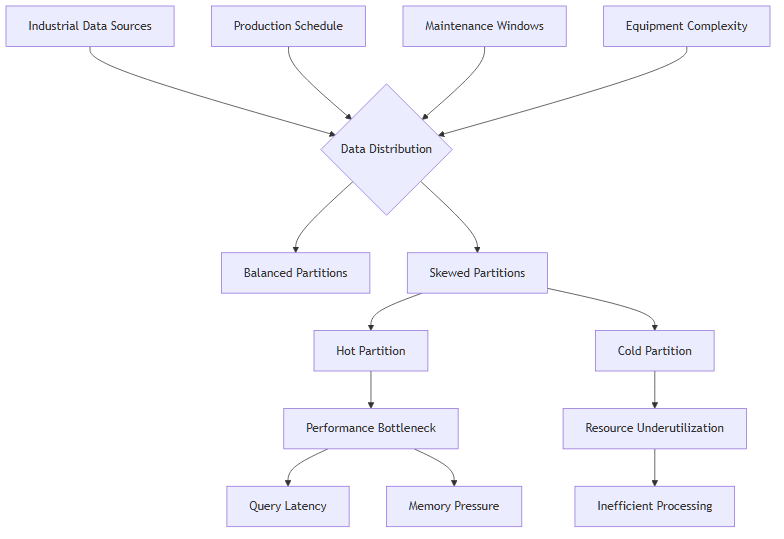
Data skew in industrial systems manifests in several distinct patterns that reflect the operational characteristics of manufacturing and research environments:
Performance Impact Analysis
Data skew creates several performance challenges that directly affect industrial data system effectiveness:
Applications and Use Cases
Manufacturing Intelligence
Production facilities experience data skew when certain manufacturing lines generate significantly more sensor data than others, or when quality control systems create data spikes during inspection periods. This skew can impact real-time monitoring and production optimization systems.
Equipment Monitoring
Different types of industrial equipment generate varying volumes of telemetry data, with complex machinery producing detailed diagnostic information while simpler equipment generates minimal monitoring data, creating natural data distribution imbalances.
Research and Development
R&D environments encounter data skew when certain experiments or simulation runs generate massive datasets while others produce minimal results, affecting the performance of analytical platforms and data storage systems.
Mitigation Strategies
Industrial organizations employ several strategies to address data skew and maintain optimal system performance:
Monitoring and Detection
Effective data skew management requires comprehensive monitoring systems that track key performance indicators:
- Partition Size Monitoring - Track data volume distribution across partitions to identify imbalances
- Access Pattern Analysis - Monitor query patterns to detect hot partitions and performance bottlenecks
- Resource Utilization Tracking - Measure CPU, memory, and I/O usage across system nodes to identify skew impacts
- Performance Metrics - Monitor query response times and throughput to assess skew effects on system performance
Prevention and Design Considerations
Preventing data skew requires careful system design and operational planning:
Related Concepts
Data skew management integrates closely with data orchestration platforms for automated rebalancing, industrial data collection systems for optimized data distribution, and data retention policies for lifecycle-based load management. It also connects with data provenance tracking to understand skew causes and supports data compression strategies for managing imbalanced storage requirements.
Understanding and managing data skew is essential for maintaining high-performance industrial data systems that can reliably support critical operational analytics, quality control processes, and research activities even as data volumes and operational complexity continue to grow.