Summary
A Data Loss Window represents the maximum amount of time during which critical industrial data might be lost in case of a system failure, network disruption, or equipment malfunction. In manufacturing and R&D environments, this metric is crucial for maintaining operational continuity and ensuring that valuable sensor data, production metrics, and experimental results are preserved even during unexpected system outages. The data loss window directly impacts predictive maintenance capabilities, quality control processes, and regulatory compliance requirements, making it a fundamental consideration in industrial data architecture design and real-time analytics system implementation.
Core Components and Factors
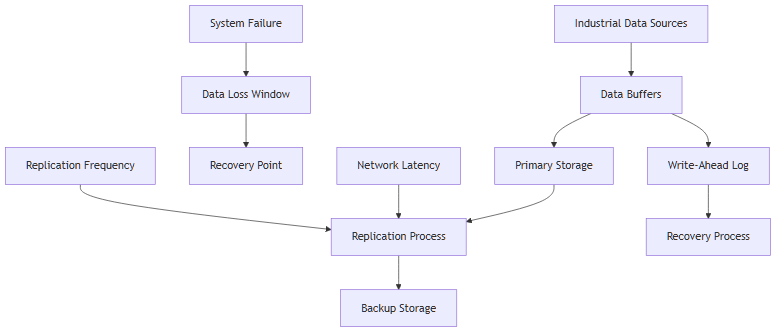
Several technical factors determine the duration of a data loss window in industrial systems:
Applications and Use Cases
Manufacturing Operations
In production environments, data loss windows directly impact the ability to track product quality, monitor equipment performance, and maintain regulatory compliance. Critical production data must be preserved to support traceability requirements and quality investigations.
Industrial R&D
Research and development activities generate valuable experimental data that cannot be recreated. Minimizing data loss windows ensures that simulation results, test measurements, and prototype performance data are preserved for analysis and future reference.
Process Control Systems
Real-time control systems require minimal data loss windows to maintain accurate process history for optimization algorithms and safety systems. Extended data loss can compromise process stability and quality control.
Tolerance Requirements by Industry
Different industrial sectors have varying tolerance levels for data loss windows:
Minimization Strategies
Industrial organizations can implement several strategies to reduce data loss windows:
Performance Considerations
Reducing data loss windows often involves trade-offs with system performance:
- Latency Impact - Synchronous replication can increase write latency
- Network Bandwidth - Frequent replication consumes network resources
- Storage Costs - Multiple copies of data increase storage requirements
- Processing Overhead - Continuous backup operations consume computational resources
Related Concepts
Data loss windows are closely related to data retention policies for long-term data management, data provenance tracking for audit trails, and industrial data collection strategies. They also connect with time-series analysis requirements and data orchestration platforms that manage data flow and backup processes.
Understanding and optimizing data loss windows is essential for maintaining the integrity and availability of industrial data systems. Organizations must balance the need for minimal data loss with practical considerations of cost, performance, and system complexity to achieve optimal operational reliability.