Summary
A Data Lakehouse is a modern data management architecture that combines the flexibility and cost-effectiveness of data lakes with the structured data management and ACID transaction support of traditional data warehouses. In industrial settings, this architecture enables organizations to store massive volumes of raw sensor data, simulation results, and operational metrics while providing reliable, high-performance analytics capabilities. The lakehouse approach is particularly valuable for manufacturing and R&D environments where data scientists need to perform complex analyses on diverse datasets while maintaining data integrity and supporting concurrent access from multiple analytical applications and real-time analytics systems.
Core Architecture Components
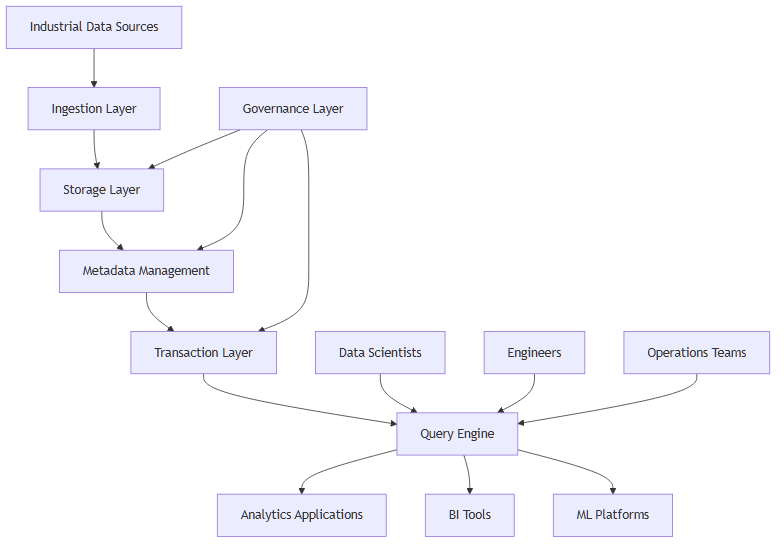
The data lakehouse architecture consists of several integrated layers that work together to provide both flexibility and reliability:
Applications and Use Cases
Manufacturing Intelligence
Data lakehouses enable manufacturers to combine real-time production data with historical performance metrics, supporting advanced analytics for quality control, yield optimization, and equipment effectiveness analysis. The architecture supports both exploratory data analysis and production-ready analytical models.
Industrial R&D
Research teams can leverage lakehouse capabilities to analyze experimental data alongside production datasets, facilitating model validation, hypothesis testing, and accelerated product development cycles. The flexible storage layer accommodates diverse data types from various testing and simulation environments.
Predictive Maintenance
The lakehouse architecture supports predictive maintenance applications by providing reliable access to historical equipment data while enabling real-time monitoring and anomaly detection. Data scientists can develop and deploy machine learning models that continuously learn from operational data.
Technical Advantages
Data lakehouses offer several key advantages for industrial applications:
Implementation Considerations
When implementing a data lakehouse for industrial environments, consider these critical factors:
Related Concepts
Data lakehouses integrate closely with data orchestration platforms for managing complex data workflows, time-series analysis techniques for temporal data processing, and industrial data collection strategies. They also support data provenance tracking and work with data retention policies to manage data lifecycle effectively.
The data lakehouse architecture represents a significant evolution in industrial data management, providing the foundation for advanced analytics while maintaining the operational reliability required in manufacturing and R&D environments. This approach enables organizations to maximize the value of their data assets while supporting both current operational needs and future analytical requirements.