Mathematical Foundation
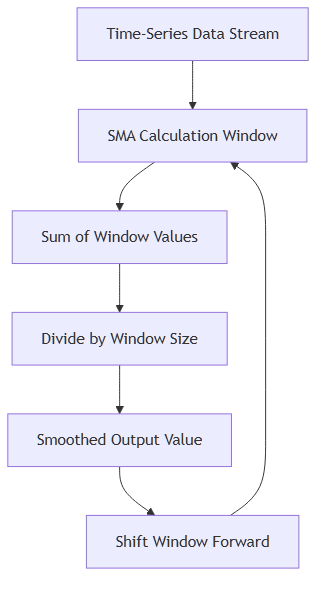
The Simple Moving Average calculates the arithmetic mean of values within a specified window period, treating all data points equally regardless of their age. The mathematical formula is:
SMA = (1/n) × Σ(Pi)
Where:
- n = number of periods in the window
- Pi = value at period i
- Σ = summation over the window period
Unlike weighted moving averages, SMA assigns equal importance to all values within the calculation window, making it a straightforward and computationally efficient smoothing technique.
Industrial Applications
Equipment Performance Monitoring
Manufacturing systems use SMA to smooth sensor readings from rotating equipment, enabling detection of gradual performance degradation while filtering out measurement noise. A 30-minute SMA of vibration data, for example, can reveal bearing wear trends that would be obscured by instantaneous fluctuations.
Process Control Systems
Temperature, pressure, and flow control systems employ SMA to create stable control signals from noisy sensor inputs. This application prevents control systems from overreacting to transient measurement variations while maintaining responsiveness to actual process changes.
Quality Control Analysis
Statistical process control implementations use SMA to establish control chart baselines and detect process variations. Moving averages of dimensional measurements, chemical compositions, or other quality parameters help distinguish between random variation and systematic changes requiring intervention.
Energy Management
Industrial energy monitoring systems apply SMA to smooth power consumption data, enabling identification of consumption patterns and energy efficiency trends across different time scales.
Implementation Considerations
Window Size Selection
The choice of window size significantly impacts SMA behavior:
# Example SMA implementation
def simple_moving_average(data, window_size):
    if len(data) < window_size:
        return []

    sma_values = []
    for i in range(window_size - 1, len(data)):
        window_sum = sum(data[i - window_size + 1:i + 1])
        sma_values.append(window_sum / window_size)

return sma_values- Short Windows (5-10 periods): More responsive to recent changes but less noise reduction
- Medium Windows (20-50 periods): Balanced response and smoothing for most industrial applications
- Long Windows (100+ periods): Maximum smoothing but significant lag in detecting changes
Real-time Processing
Industrial monitoring systems require efficient SMA calculation for real-time data streams. Implementations typically use circular buffers to maintain the calculation window without storing the entire data history.
Memory Management
For systems processing thousands of sensor channels, memory-efficient SMA algorithms are crucial. Sliding window implementations that maintain only the current window values minimize memory requirements while enabling continuous calculation.
Advantages and Limitations
Advantages
Limitations
Best Practices for Industrial Systems
Integration with Advanced Analytics
Simple Moving Average often serves as a preprocessing step for more sophisticated analysis techniques including time-series analysis, anomaly detection, and predictive maintenance algorithms. The smoothed data from SMA calculations provides cleaner inputs for machine learning models and statistical analysis.
Simple Moving Average represents a foundational technique for industrial data processing, offering reliable trend identification and noise reduction capabilities essential for effective monitoring and control of complex industrial systems.