Understanding Signal Smoothing
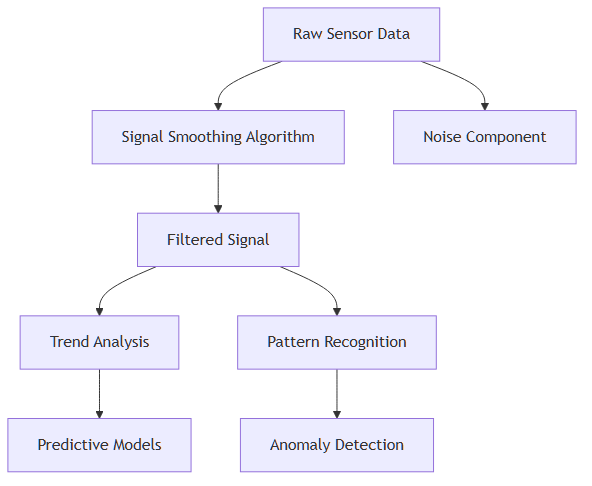
Signal smoothing addresses the fundamental challenge of extracting meaningful patterns from noisy sensor data. Industrial environments generate continuous streams of measurements that contain both valuable information about system behavior and unwanted noise from various sources including electromagnetic interference, vibration, temperature fluctuations, and measurement device limitations.
The smoothing process involves applying mathematical algorithms that selectively reduce high-frequency noise while preserving lower-frequency trends and patterns essential for analysis and decision-making.
Common Smoothing Techniques
Moving Average Filters
Moving averages replace each data point with the average of surrounding values within a specified window. This approach effectively reduces random noise while maintaining computational efficiency for real-time applications.
# Simple moving average implementation
def moving_average(data, window_size):
    smoothed = []
    for i in range(len(data) - window_size + 1):
        window = data[i:i + window_size]
        smoothed.append(sum(window) / window_size)
    return smoothed
Exponential Smoothing
Exponential smoothing assigns exponentially decreasing weights to older observations, making it particularly effective for trend detection and forecasting applications where recent data points are more relevant.
Gaussian Filters
Gaussian filters apply weighted averages using a Gaussian distribution, providing superior noise reduction while preserving edge characteristics important for detecting sudden changes in industrial processes.
Applications in Industrial Systems
Vibration Monitoring
Rotating equipment monitoring relies on signal smoothing to extract meaningful vibration patterns from noisy accelerometer data. Smoothing enables detection of bearing wear, misalignment, and other mechanical issues that manifest as gradual changes in vibration characteristics.
Temperature Control Systems
Process control applications use signal smoothing to filter temperature sensor readings, preventing control systems from responding to transient noise while maintaining sensitivity to actual process changes.
Flow Measurement
Flow meters in industrial processes often exhibit measurement noise due to turbulence and pressure fluctuations. Signal smoothing enables accurate flow calculation and process optimization while maintaining responsiveness to actual flow changes.
Quality Control Monitoring
Manufacturing quality control systems employ signal smoothing to distinguish between actual product variations and measurement noise, improving the accuracy of statistical process control and reducing false alarms.
Implementation Considerations
Window Size Selection
The choice of smoothing window size creates a fundamental trade-off between noise reduction and responsiveness:
- Larger Windows: More aggressive noise reduction but slower response to actual changes
- Smaller Windows: Better responsiveness but less effective noise reduction
- Adaptive Windows: Dynamic adjustment based on signal characteristics
Real-time Processing Requirements
Industrial applications often require real-time signal processing with minimal latency. Smoothing algorithms must balance computational efficiency with filtering effectiveness to meet timing constraints.
Edge Effects Management
Signal smoothing algorithms must handle data boundaries effectively, particularly for continuous monitoring applications where new data arrives constantly.
Best Practices for Industrial Environments
Performance Optimization
Effective signal smoothing implementation requires consideration of computational resources, memory usage, and processing latency. Modern industrial systems often process thousands of sensor channels simultaneously, requiring efficient algorithms and parallel processing capabilities.
Signal smoothing forms an essential component of industrial data processing pipelines, enabling organizations to extract reliable insights from noisy sensor data while maintaining the responsiveness required for effective process control and condition monitoring applications.