Understanding Lakehouse Architecture Fundamentals
Industrial environments generate diverse data types including sensor measurements, equipment telemetry, process control data, and maintenance records. Traditional architectures require separate systems for raw data storage (data lakes) and structured analytics (data warehouses), creating complexity and duplication. Lakehouse architecture eliminates this dichotomy by providing a unified platform that handles both raw data ingestion and structured analytical processing.
The architecture maintains ACID transaction guarantees while supporting massive scale storage, enabling industrial organizations to manage petabytes of historical data alongside real-time operational analytics. This unified approach reduces data movement overhead and eliminates the need for complex ETL processes between storage and analytical systems.
Core Architectural Components
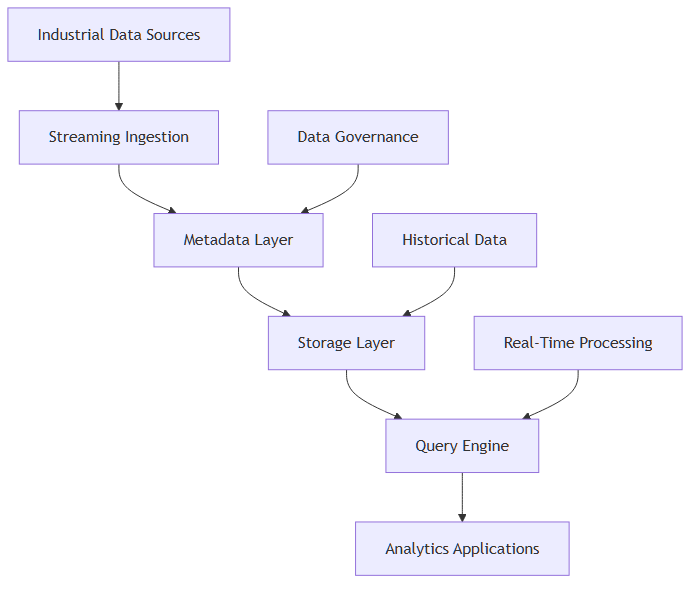
Industrial lakehouse implementations comprise several integrated layers that provide comprehensive data management capabilities:
Applications in Industrial Data Processing
Manufacturing Process Analytics
Lakehouse architecture enables comprehensive analysis of manufacturing data by combining real-time production metrics with historical quality data, equipment maintenance records, and process parameters. This unified view supports process optimization and quality improvement initiatives.
Equipment Lifecycle Management
Industrial equipment generates data throughout its operational lifecycle. Lakehouse systems store design specifications, installation data, operational telemetry, maintenance history, and performance analytics in a unified repository that supports predictive maintenance and asset optimization.
Energy Management Systems
Industrial energy management requires correlation of consumption data with production output, environmental conditions, and equipment operational states. Lakehouse architecture enables comprehensive energy analytics by combining diverse data sources in a unified analytical environment.
Performance Optimization Features
Automatic Data Tiering
Lakehouse systems automatically organize industrial data based on access patterns, moving frequently accessed operational data to high-performance storage while archiving historical data to cost-effective storage tiers.
Intelligent Caching
Advanced caching mechanisms optimize query performance for common industrial analytics patterns, including time-series aggregations, equipment performance comparisons, and process trend analysis.
Column Pruning and Predicate Pushdown
Query optimization techniques reduce data scanning overhead by processing only relevant columns and applying filters at the storage layer, improving performance for large-scale industrial analytics.
Implementation Strategies
# Example lakehouse configuration for industrial data
lakehouse_config:
  storage:
    format: "delta"
    compression: "zstd"
    partitioning: ["year", "month", "equipment_type"]

  metadata:
    schema_evolution: "automatic"
    versioning: "enabled"
    governance: "rbac"

  ingestion:
    streaming_formats: ["json", "parquet", "avro"]
    batch_processing: "scheduled"
    real_time_latency: "sub_second"

  analytics:
    sql_engine: "spark"
    time_series_functions: "enabled"
    machine_learning: "integrated"
Data Governance and Security
Industrial lakehouse implementations require robust governance frameworks:
Technology Ecosystem
Open-Source Implementations
Popular open-source lakehouse technologies include Apache Iceberg, Apache Hudi, and Delta Lake, each providing different capabilities for industrial data management and analytics.
Cloud Integration
Major cloud platforms offer managed lakehouse services that integrate with industrial IoT platforms, edge computing systems, and enterprise analytics tools.
Vendor Solutions
Commercial lakehouse platforms provide industrial-specific features including OT/IT integration, industrial protocol support, and specialized time-series analytics capabilities.
Related Concepts
Lakehouse architecture integrates with data streaming systems, industrial data historians, and time-series analysis platforms. Understanding these relationships enables comprehensive data architecture design that supports both operational monitoring and strategic analytics requirements.
Effective lakehouse implementation represents a transformative approach for industrial data management, enabling organizations to unify diverse data sources while maintaining performance, governance, and analytical capabilities essential for modern manufacturing and process control environments.