Understanding Ingestion Timestamp Fundamentals
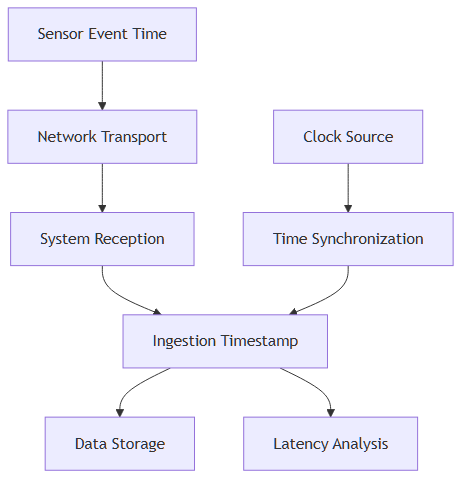
Industrial data systems must distinguish between when events actually occurred in the physical world and when that data reached the processing system. The ingestion timestamp captures this arrival time, enabling analysis of ingestion latency, system performance, and data flow patterns across complex industrial networks.
This temporal distinction becomes crucial when analyzing equipment performance, process efficiency, and system reliability. Manufacturing environments with distributed sensors, network delays, and varying communication protocols rely on ingestion timestamps to understand data freshness and processing characteristics.
Core Timestamp Components
Industrial ingestion timestamps encompass several critical elements that ensure temporal accuracy and system reliability:
Applications in Industrial Data Processing
Process Control Timing Analysis
Industrial process control systems use ingestion timestamps to measure control loop response times, validate real-time requirements, and optimize system performance. Understanding when data arrives relative to when it was generated enables control system tuning.
Equipment Performance Monitoring
Manufacturing equipment monitoring relies on ingestion timestamps to correlate equipment events with data availability, enabling analysis of communication delays and system responsiveness for predictive maintenance applications.
Data Quality Assessment
Quality management systems employ ingestion timestamps to assess data freshness, identify communication issues, and validate that measurements remain within acceptable latency thresholds for process control and safety systems.
Timestamp Precision and Synchronization
High-Precision Requirements
Industrial applications often demand microsecond-level timestamp precision to support high-frequency data collection, control system responsiveness, and precise event correlation across distributed systems.
Synchronization Strategies
Manufacturing facilities implement sophisticated time synchronization strategies using GPS receivers, atomic clocks, and network synchronization protocols to maintain temporal accuracy across plant-wide systems.
Clock Drift Management
Industrial systems monitor and compensate for clock drift between data sources and processing systems, ensuring that ingestion timestamps remain accurate over extended operational periods.
Implementation Considerations
# Example ingestion timestamp configuration
timestamp_config = {
    "precision": "microseconds",
    "timezone": "UTC",
    "synchronization": {
        "protocol": "PTP",
        "drift_tolerance": "1ms",
        "sync_interval": "1s"
    },
    "storage": {
        "index_type": "btree",
        "compression": "delta_encoding"
    }
}
Performance and Storage Impact
Industrial ingestion timestamps introduce several system considerations:
Best Practices for Industrial Applications
Related Concepts
Ingestion timestamps integrate closely with time-series analysis, data streaming architectures, and industrial data historians. Understanding these relationships enables comprehensive temporal data management that supports both operational monitoring and analytical requirements.
Effective ingestion timestamp management represents a critical capability for industrial data systems, enabling precise temporal tracking, performance analysis, and data quality assessment while supporting the timing requirements of modern manufacturing and process control environments.