Summary
A Data Lake Query Engine is a distributed computing system that enables SQL-like querying and analysis of massive volumes of industrial data stored in data lakes. For industrial R&D and manufacturing environments, these engines provide the computational power to analyze heterogeneous datasets including sensor readings, simulation results, and operational metrics without requiring complex data transformation processes. Query engines are essential for enabling engineers to perform ad-hoc analysis, generate insights from historical data, and support real-time analytics for process optimization and predictive maintenance applications.
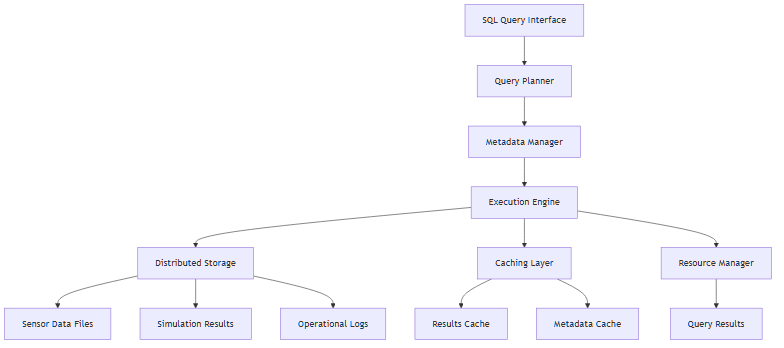
Core Architecture Components
Industrial data lake query engines are built on several key architectural components designed to handle the unique challenges of manufacturing and R&D data:
Applications and Use Cases
Industrial Data Analysis
Query engines enable engineers to analyze production data across multiple time periods and manufacturing lines using familiar SQL syntax. This capability supports root cause analysis, quality investigations, and performance benchmarking without requiring specialized programming skills.
Simulation Data Processing
In R&D environments, query engines facilitate the analysis of large-scale simulation datasets, enabling engineers to compare simulation results with actual operational data and validate model accuracy across different operating conditions.
Cross-System Analytics
Query engines can federate data from multiple industrial systems, allowing analysts to correlate information from PLCs, SCADA systems, MES platforms, and external databases within a single analytical framework.
Performance Optimization Techniques
Modern data lake query engines employ several optimization strategies particularly valuable for industrial applications:
Implementation Considerations
When deploying data lake query engines in industrial environments, several factors must be considered:
Related Concepts
Data lake query engines work closely with data partitioning strategies for optimal performance, data compression techniques for efficient storage, and time-series analysis methods for temporal data processing. They also integrate with data orchestration platforms and support industrial data collection workflows by providing the analytical layer for processed data.
The effectiveness of industrial data lake query engines ultimately depends on their ability to provide fast, reliable access to diverse data sources while maintaining the flexibility to adapt to evolving analytical requirements and technological advances in manufacturing and R&D environments.