Understanding Backpressure Mechanisms
Backpressure operates as a dynamic flow control system that prevents buffer overflow and system crashes in streaming architectures. When downstream components signal their processing capacity limits, upstream components automatically adjust their transmission rates to match the system's ability to process data.
In industrial contexts, backpressure is essential for managing temporary data surges that occur during equipment startups, process transitions, or when multiple manufacturing lines simultaneously report telemetry data. The mechanism ensures that critical operational data is preserved and processed reliably, even under high-volume conditions.
Core Implementation Components
Backpressure systems utilize several technical approaches to maintain data flow balance:
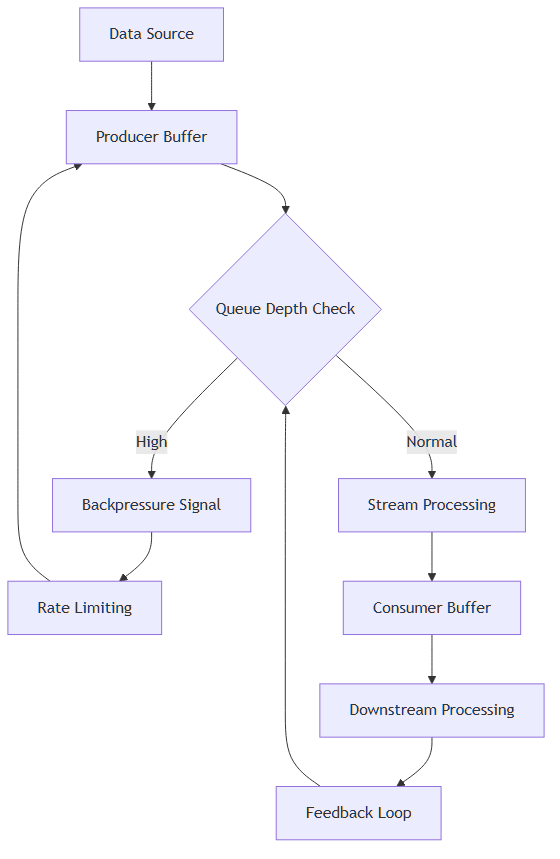
Applications in Industrial Systems
Manufacturing Process Control
In Model-Based Design environments, backpressure mechanisms protect control systems from data overload during critical manufacturing processes. When process variables change rapidly, backpressure ensures that control algorithms receive data at manageable rates, preventing system instability.
Sensor Network Management
Industrial IoT networks generate varying data volumes based on operational conditions. Backpressure mechanisms automatically adjust sensor sampling rates and transmission frequencies to match network capacity, ensuring consistent data collection without overwhelming downstream analytics systems.
Predictive Maintenance Systems
Predictive maintenance applications rely on continuous equipment telemetry streams. Backpressure prevents data loss during maintenance window transitions when systems may temporarily operate at reduced capacity while maintaining historical data continuity.
Performance Optimization Strategies
Effective backpressure implementation requires careful balance between system protection and performance:
- Adaptive Rate Limiting: Algorithms that dynamically adjust transmission rates based on real-time system capacity metrics
- Priority-Based Flow Control: Critical data streams receive higher transmission priority during backpressure events
- Memory Optimization: Efficient buffer management reduces memory footprint while maintaining adequate surge capacity
- Latency Minimization: Backpressure mechanisms minimize processing delays to preserve real-time system responsiveness
Implementation Best Practices
System Architecture Considerations
Backpressure mechanisms must integrate seamlessly with existing industrial architectures:
- Distributed System Coordination: Backpressure signals must propagate efficiently across distributed processing nodes
- Protocol Compatibility: Flow control mechanisms must support standard industrial communication protocols
- Resource Allocation: Dynamic resource allocation ensures optimal utilization during varying load conditions
- Fault Tolerance: Backpressure systems must continue operating even when individual components fail
Performance Trade-offs
Implementing backpressure involves several important trade-offs:
- Throughput vs. Stability: Aggressive backpressure provides system stability but may reduce overall throughput
- Latency vs. Reliability: Buffer management adds processing latency but ensures data reliability
- Memory Usage vs. Surge Capacity: Larger buffers handle data surges better but consume more system memory
- Processing Overhead: Continuous monitoring and flow control add computational overhead
Related Concepts
Backpressure mechanisms work in conjunction with load balancing and fault tolerance systems. They integrate with event-driven architectures and support batch processing workflows by providing controlled data flow management.
The concept is particularly valuable in industrial environments where telemetry data volumes can vary significantly based on operational conditions, equipment states, and process transitions, requiring robust flow control to maintain system reliability and data integrity.