Understanding Backfill Operations
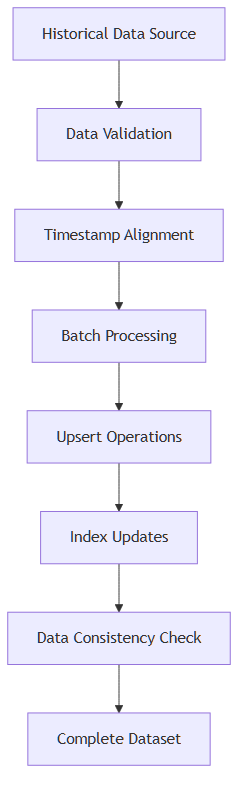
Backfill operations address the common challenge of incomplete historical data in industrial systems. Unlike real-time data ingestion, backfill processes handle data that arrives out-of-order or requires retroactive insertion at specific timestamps. This capability is essential for industrial environments where sensor networks may experience intermittent connectivity, equipment downtime, or data collection failures.
The process involves timestamp alignment to ensure data points are correctly positioned within the temporal sequence. Modern industrial systems must handle scenarios where maintenance logs, quality control measurements, or equipment telemetry arrive hours or days after the actual events occurred.
Core Implementation Mechanisms
Backfill operations utilize several technical approaches to maintain data consistency:
Applications in Industrial Systems
Manufacturing Quality Control
Backfill operations enable the integration of delayed quality inspection results with production telemetry. When laboratory test results become available days after production, backfill processes ensure these measurements are correctly associated with their corresponding production batches, enabling comprehensive quality trend analysis.
Energy Grid Management
Power grid operators use backfill to reconcile meter readings, incorporate weather data corrections, and update consumption patterns. This ensures accurate billing calculations and enables precise demand forecasting for grid optimization.
Model-Based Design Validation
In Model-Based Design workflows, backfill operations incorporate test results and validation data that may be generated after initial model runs. This enables engineers to maintain complete datasets for model performance evaluation and design iteration tracking.
Performance Considerations
Backfill operations present unique performance challenges that require careful resource management:
- Write Amplification: Inserting historical data into existing time-series structures can trigger expensive rewrite operations
- Query Performance Impact: Real-time queries may experience degraded performance during large backfill operations
- Memory Usage: Batch processing requires substantial memory allocation for sorting and deduplication operations
- Storage Reorganization: Time-based partitions may require restructuring to accommodate historical data insertion
Effective backfill implementations use resource throttling to limit impact on operational systems and schedule operations during maintenance windows.
Implementation Best Practices
Data Consistency Challenges
Backfill operations must address several consistency challenges:
- Timestamp Conflicts: Handling scenarios where multiple data points claim the same timestamp
- Aggregation Recalculation: Updating pre-computed aggregations when historical data changes
- Cross-System Synchronization: Ensuring backfill operations maintain consistency across distributed systems
- Audit Trail Maintenance: Preserving data lineage information when historical records are modified
Related Concepts
Backfill operations integrate closely with data streaming architectures and batch processing systems. They support data reconciliation workflows and enable comprehensive operational analytics by ensuring complete historical datasets.
The capability is particularly valuable in industrial contexts where sensor data collection may be interrupted by network outages, equipment maintenance, or system failures, requiring retroactive data recovery and integration.