Core Concepts
Append-only storage treats data as an immutable log of events where each new data point is sequentially written to the end of the storage structure. This design pattern eliminates the need for random disk access during data ingestion, making it particularly well-suited for industrial applications that generate continuous streams of sensor data, telemetry, and system events.
The fundamental principle revolves around sequential write operations that maximize disk throughput while minimizing disk seek operations. Unlike traditional database systems that support in-place updates, append-only storage preserves the complete history of data changes, creating a comprehensive audit trail that is essential for compliance and forensic analysis in industrial environments.
How Append-only Storage Works
The operational mechanism of append-only storage follows these key components:
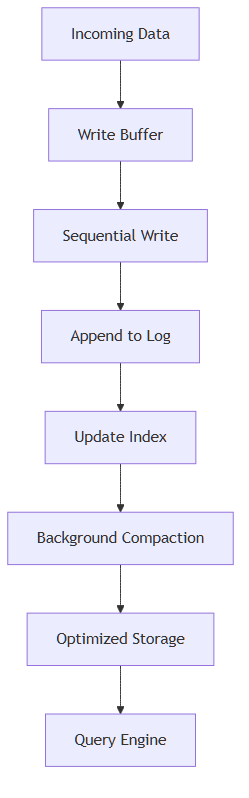
Applications in Industrial Systems
Industrial Data Collection
Append-only storage excels in handling high-volume sensor data streams from manufacturing equipment, environmental monitoring systems, and process control networks. The sequential write pattern accommodates the continuous nature of industrial telemetry without creating bottlenecks.
Model-Based Design Integration
In Model-Based Design workflows, append-only storage maintains complete histories of simulation runs, test results, and model iterations. This enables engineers to trace design decisions and validate model performance over time.
Predictive Maintenance Systems
The immutable nature of append-only storage supports predictive maintenance applications by preserving the complete operational history of equipment. This historical data is crucial for training machine learning models and identifying degradation patterns.
Performance Considerations
Append-only storage delivers significant performance advantages for write-heavy workloads:
- High Ingestion Throughput: Sequential writes can achieve disk bandwidth utilization exceeding 90%
- Reduced Write Amplification: Eliminates the overhead of updating existing records and maintaining complex index structures
- Improved Cache Efficiency: Recent data remains in memory caches, accelerating query performance for time-based access patterns
However, query performance requires careful optimization through partition pruning and columnar storage formats to limit scan ranges and reduce I/O operations.
Implementation Best Practices
Related Concepts
Append-only storage integrates closely with data streaming architectures and event-driven systems. It serves as the foundation for implementing change data capture patterns and supports advanced analytics through batch processing and real-time windowing functions.
The pattern is particularly valuable in industrial contexts where data lineage, regulatory compliance, and system auditability are paramount requirements for operational excellence and quality assurance.