Understanding Alert Thresholding Fundamentals
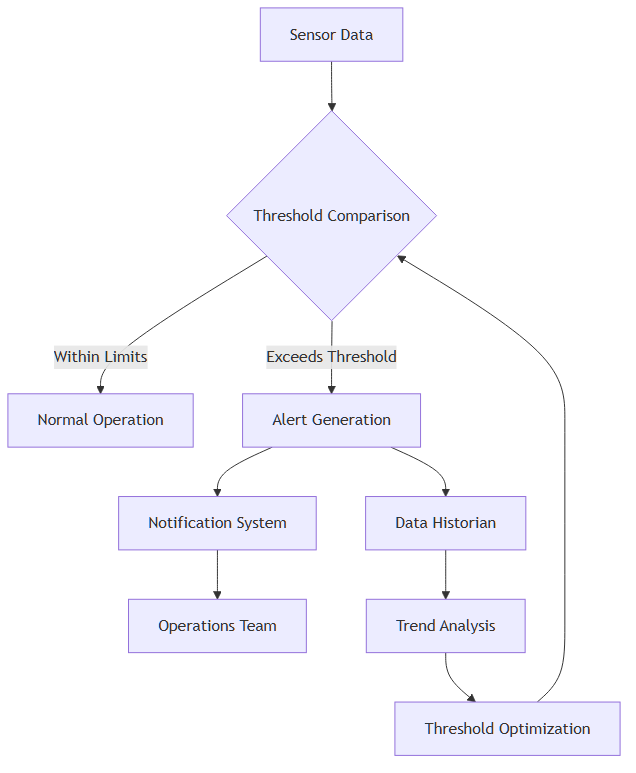
Alert thresholding operates on the principle of continuous comparison between real-time sensor data and established operational boundaries. In industrial settings, these boundaries represent the acceptable operating envelope for machinery, processes, and environmental conditions. When measurements exceed these limits, the system immediately generates alerts to notify operations personnel.
Unlike simple static limits, modern alert thresholding systems incorporate sophisticated logic to handle the complexity of industrial operations. They account for normal operational variations, equipment warm-up periods, and scheduled maintenance activities to minimize false alarms while ensuring genuine issues are detected promptly.
Core Components
Alert thresholding systems consist of several key elements working together:
The effectiveness of these systems depends heavily on proper configuration and regular maintenance of threshold values based on operational experience and equipment characteristics.
Types of Thresholds in Industrial Applications
Static Thresholds
Static thresholds use fixed values that remain constant throughout operation. These are suitable for parameters with well-defined safe operating limits, such as:
- Maximum bearing temperatures (e.g., "Temperature > 75°C")
- Minimum oil pressure levels (e.g., "Pressure < 2.5 bar")
- Maximum vibration amplitudes (e.g., "Vibration > 10 mm/s")
Dynamic Thresholds
Dynamic thresholds adapt to changing operational conditions using:
- Moving averages to account for gradual process changes
- Seasonal adjustments for temperature-dependent processes
- Machine learning techniques that learn normal operational patterns
Applications in Industrial Systems
Manufacturing Process Control
Alert thresholding is crucial for maintaining product quality and equipment reliability. Temperature monitoring in heat treatment processes, pressure monitoring in hydraulic systems, and flow rate monitoring in chemical processes all rely on properly configured thresholds.
Predictive Maintenance
By monitoring equipment health parameters such as vibration, temperature, and electrical signatures, alert thresholding enables early detection of degrading components before failure occurs. This approach is fundamental to condition-based maintenance strategies.
Safety Systems
Critical safety parameters require immediate attention when thresholds are exceeded. Gas detection systems, emergency shutdown procedures, and fire suppression systems all depend on reliable threshold monitoring to protect personnel and equipment.
Implementation Considerations
Integration with Model Based Design
In Model Based Design environments, alert thresholds are often derived from simulation models that predict optimal operating conditions. This approach ensures that thresholds reflect actual system behavior rather than arbitrary values, leading to more effective monitoring and reduced false alarms.
Performance Considerations
Alert thresholding systems must balance sensitivity with stability. Overly sensitive thresholds generate excessive false alarms, leading to alert fatigue and potentially ignored critical warnings. Conversely, insensitive thresholds may miss important early warning signs of equipment problems.
Modern systems employ sophisticated algorithms including anomaly detection techniques and time series analysis to optimize threshold performance while maintaining system responsiveness.
Alert thresholding remains a cornerstone of industrial monitoring systems, providing the foundation for safe, efficient, and reliable operations across diverse manufacturing and process industries.