Understanding Condition Based Maintenance Fundamentals
Condition Based Maintenance represents a paradigm shift from reactive maintenance (fixing equipment after failure) and preventive maintenance (scheduled maintenance regardless of condition) to a proactive approach based on actual equipment health indicators. This strategy relies on continuous monitoring of equipment parameters such as vibration, temperature, pressure, and acoustic emissions.
CBM systems use sophisticated data analysis techniques to establish baseline equipment behavior, detect deviations from normal operation, and predict when maintenance interventions are required. This approach optimizes maintenance timing to prevent failures while avoiding unnecessary maintenance activities.
Core Components of Condition Based Maintenance
Condition Based Maintenance Workflow
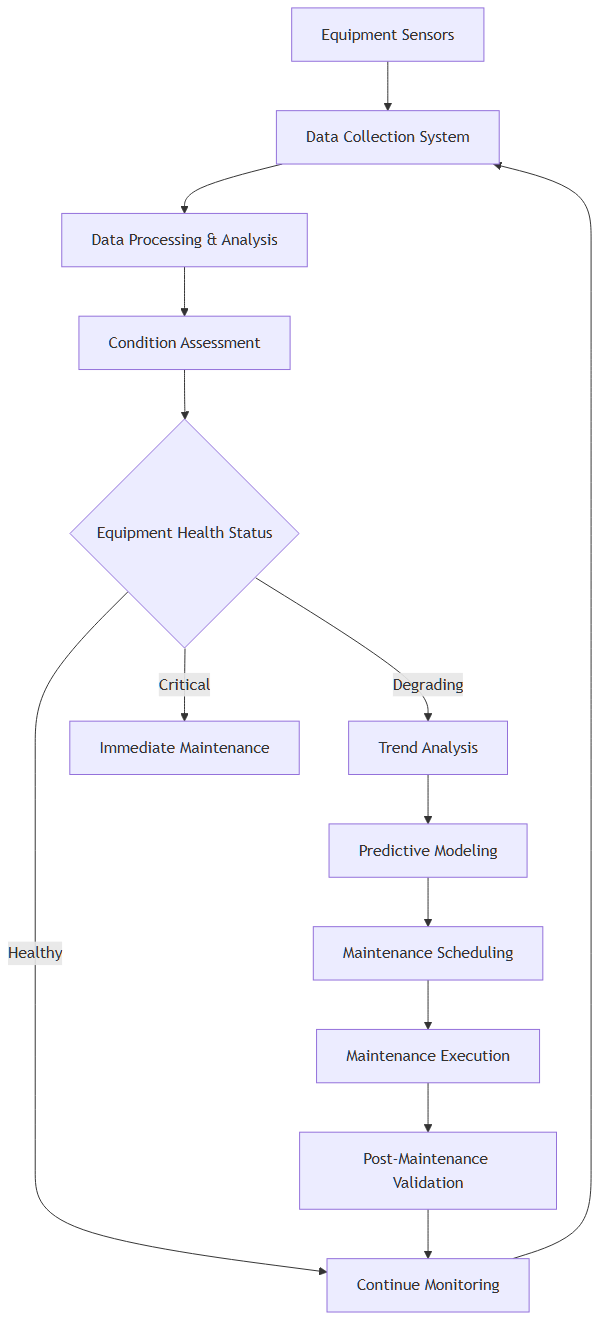
Applications in Industrial Environments
Rotating Equipment Monitoring
CBM systems monitor pumps, compressors, and turbines using vibration analysis, oil analysis, and thermal imaging to detect bearing wear, misalignment, and imbalance conditions.
Manufacturing Equipment
Production machinery benefits from CBM through monitoring of cutting tool wear, machine tool accuracy, and process parameter variations that affect product quality.
Power Generation
Power plants use CBM to monitor turbines, generators, and auxiliary systems, optimizing maintenance windows during planned outages and preventing costly unplanned shutdowns.
Model Based Design Integration
MBD environments leverage CBM data to validate simulation models, improve design decisions, and optimize maintenance strategies for new equipment designs.
Implementation Technologies
# Example CBM data processing pipeline
import numpy as np
import pandas as pd
from sklearn.ensemble import IsolationForest
from sklearn.preprocessing import StandardScaler
from datetime import datetime, timedelta

class CBMAnalyzer:
    def __init__(self):
        self.scaler = StandardScaler()
        self.anomaly_detector = IsolationForest(contamination=0.1)
        self.baseline_established = False
        self.alert_threshold = 0.8

    def establish_baseline(self, historical_data: pd.DataFrame):
        """Establish normal operating conditions baseline"""
        features = ['vibration', 'temperature', 'pressure', 'current']
        normalized_data = self.scaler.fit_transform(historical_data[features])
        self.anomaly_detector.fit(normalized_data)
        self.baseline_established = True

    def analyze_condition(self, current_data: pd.DataFrame) -> dict:
        """Analyze current equipment condition"""
        if not self.baseline_established:
            return {'status': 'baseline_required'}

        features = ['vibration', 'temperature', 'pressure', 'current']
        normalized_data = self.scaler.transform(current_data[features])

        # Anomaly detection
        anomaly_scores = self.anomaly_detector.decision_function(normalized_data)
        anomaly_predictions = self.anomaly_detector.predict(normalized_data)

        # Trend analysis
        trend_analysis = self.analyze_trends(current_data)

        # Overall health assessment
        health_score = self.calculate_health_score(anomaly_scores, trend_analysis)

        return {
            'health_score': health_score,
            'anomaly_detected': any(anomaly_predictions == -1),
            'trend_analysis': trend_analysis,
            'maintenance_recommendation': self.generate_recommendation(health_score)
        }

    def analyze_trends(self, data: pd.DataFrame) -> dict:
        """Analyze parameter trends over time"""
        trends = {}
        for column in ['vibration', 'temperature', 'pressure']:
            if len(data) > 10:
                slope = np.polyfit(range(len(data)), data[column], 1)[0]
                trends[column] = {'slope': slope, 'trend': 'increasing' if slope > 0 else 'decreasing'}
        return trends

    def calculate_health_score(self, anomaly_scores: np.ndarray, trend_analysis: dict) -> float:
        """Calculate overall equipment health score (0-1)"""
        base_score = np.mean(anomaly_scores)

        # Adjust based on trend severity
        trend_penalty = 0
        for param, trend_info in trend_analysis.items():
            if abs(trend_info['slope']) > 0.1:  # Significant trend
                trend_penalty += 0.1

        health_score = max(0, min(1, base_score - trend_penalty))
        return health_score

    def generate_recommendation(self, health_score: float) -> str:
        """Generate maintenance recommendation"""
        if health_score > 0.8:
            return "Equipment healthy - continue monitoring"
        elif health_score > 0.5:
            return "Schedule maintenance within 30 days"
        else:
            return "Immediate maintenance required"
Key Benefits
Cost Reduction
CBM reduces maintenance costs by performing maintenance only when needed, minimizing unnecessary interventions and associated labor and material costs.
Increased Equipment Reliability
By addressing issues before they cause failures, CBM improves equipment reliability and reduces unplanned downtime.
Extended Equipment Life
Optimal maintenance timing based on actual condition helps extend equipment lifespan and maximize return on investment.
Improved Safety
Early detection of potential equipment failures reduces safety risks associated with unexpected equipment breakdowns.
Data Requirements
Effective CBM implementation requires:
- High-Quality Sensors: Accurate, reliable sensors for monitoring critical parameters
- Continuous Data Collection: Uninterrupted data streams for trend analysis
- Historical Data: Baseline information for establishing normal operating conditions
- Contextual Information: Operating conditions, load variations, and environmental factors
Best Practices
Challenges and Solutions
Data Quality Issues
Poor sensor calibration or environmental interference can compromise CBM effectiveness. Regular sensor maintenance and data validation procedures are essential.
False Alarms
Overly sensitive detection algorithms can generate false alarms. Proper algorithm tuning and multi-parameter analysis help reduce false positives.
Integration Complexity
CBM systems must integrate with existing maintenance management systems and operational procedures. Gradual implementation and change management are crucial.
Related Concepts
Condition Based Maintenance integrates with predictive maintenance, anomaly detection, and sensor data processing. It also supports industrial automation and manufacturing intelligence initiatives.
Condition Based Maintenance represents a fundamental shift toward intelligent, data-driven maintenance strategies that optimize equipment performance, reduce costs, and improve operational reliability. This approach enables organizations to move from reactive maintenance practices to proactive, condition-based strategies that maximize equipment value and operational efficiency.