Understanding Sliding Window Mechanics
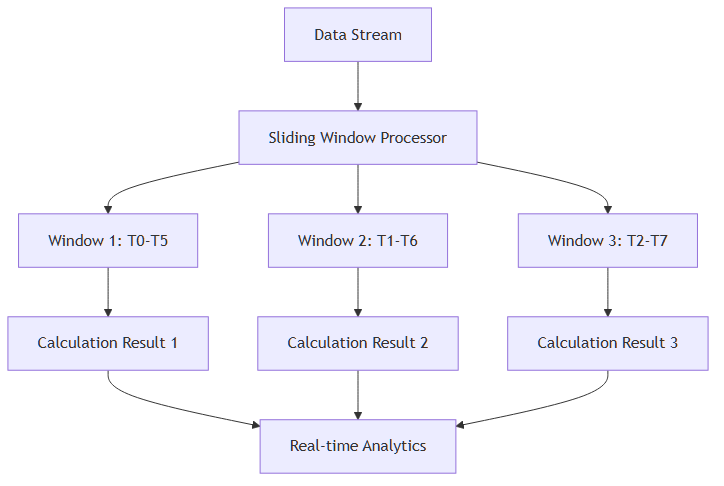
Sliding Window operates by maintaining a fixed-size data window that moves through time-series data as new observations arrive. Unlike static analysis windows, sliding windows provide continuous updates to calculations, enabling real-time insights into system behavior and performance trends.
The core components of a sliding window system include:
Implementation Strategies
Time-Based Windows
Industrial monitoring systems commonly use time-based sliding windows to analyze sensor data over specific durations. For example, a 5-minute sliding window updating every 30 seconds provides near real-time analysis of equipment performance trends.
# Example sliding window implementation
class SlidingWindow:
    def __init__(self, window_size, slide_interval):
        self.window_size = window_size
        self.slide_interval = slide_interval
        self.data_buffer = []

    def add_data(self, value, timestamp):
        # Add new data point
        self.data_buffer.append((value, timestamp))

        # Remove data outside window
        cutoff_time = timestamp - self.window_size
        self.data_buffer = [(v, t) for v, t in self.data_buffer
                           if t >= cutoff_time]

        return self.calculate_metrics()

    def calculate_metrics(self):
        if not self.data_buffer:
            return None
        values = [v for v, t in self.data_buffer]
        return {
            'mean': sum(values) / len(values),
            'min': min(values),
            'max': max(values),
            'count': len(values)
        }
Count-Based Windows
Manufacturing quality control systems often employ count-based sliding windows that maintain a fixed number of recent measurements regardless of timing, ensuring consistent sample sizes for statistical analysis.
Event-Driven Windows
Process control applications may use event-driven sliding windows that adjust boundaries based on system state changes, providing analysis periods aligned with operational phases rather than fixed time intervals.
Industrial Applications
Equipment Condition Monitoring
Rotating machinery monitoring uses sliding windows to calculate vibration statistics, enabling early detection of bearing wear, misalignment, and other mechanical issues. Continuous updates provide immediate notification of developing problems.
Process Control Optimization
Chemical and manufacturing processes employ sliding window analysis to monitor process variables, detecting deviations from normal operating ranges and triggering corrective actions before quality issues occur.
Energy Management
Industrial energy monitoring systems use sliding windows to track power consumption patterns, identifying inefficiencies and optimizing equipment operation schedules based on real-time usage trends.
Quality Assurance
Production line quality control implements sliding window analysis of dimensional measurements, surface finish characteristics, and other quality metrics to ensure continuous process capability.
Performance Optimization
Memory Management
Efficient sliding window implementations use circular buffers and data structures that minimize memory allocation and deallocation overhead while maintaining fast access to window data.
Incremental Calculations
Advanced implementations employ incremental calculation techniques that update statistical measures by adding new values and removing expired values rather than recalculating from scratch.
Parallel Processing
Multi-sensor industrial systems benefit from parallel sliding window processing, where independent windows operate simultaneously across different data streams without interference.
Best Practices for Industrial Systems
Integration with Analytics Pipelines
Sliding windows often serve as foundational components in larger analytics pipelines, providing preprocessed data for anomaly detection, predictive maintenance algorithms, and machine learning models. The continuous output from sliding window calculations enables responsive decision-making systems.
Sliding Window techniques provide the temporal analysis capabilities essential for modern industrial monitoring and control systems, enabling organizations to maintain continuous insight into system performance while supporting the real-time decision-making requirements of advanced manufacturing and process control applications.