Understanding Sensor ID Mapping
Sensor ID Mapping addresses the fundamental challenge of connecting physical devices to their digital representations in data systems. Industrial environments typically contain hundreds or thousands of sensors, each requiring unique identification and metadata management to ensure data integrity and operational effectiveness.
The mapping process involves multiple layers of identification:
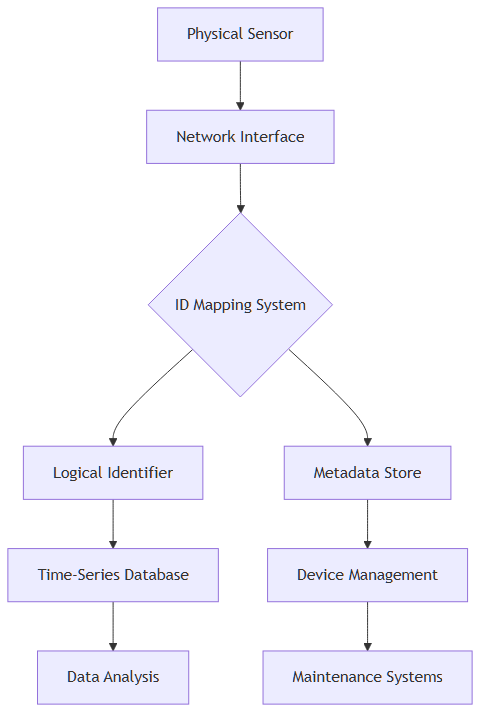
Implementation in Industrial Systems
Manufacturing Floor Integration
In manufacturing environments, Sensor ID Mapping enables tracking of sensors across production lines, quality control stations, and environmental monitoring points. Each sensor's physical location, calibration status, and maintenance history must be accurately mapped to ensure data integrity and operational continuity.
Process Control Applications
Process control systems rely on precise sensor identification for safety-critical operations. Mapping systems must maintain real-time updates of sensor status, configuration changes, and replacement activities to ensure control algorithms receive data from the correct sources.
Asset Performance Monitoring
Equipment performance monitoring requires stable sensor-to-asset relationships over extended periods. Sensor ID Mapping maintains these relationships through equipment modifications, sensor replacements, and system upgrades.
Technical Architecture Components
Identity Resolution Engine
The core mapping system must resolve multiple identifier types and maintain consistency across system boundaries:
# Example sensor mapping structure
sensor_mapping = {
    "physical_id": "SN-12345-ABC",
    "logical_id": "uuid-4a2b3c4d-5e6f",
    "network_id": "192.168.1.100",
    "location": "Line-A-Station-3",
    "asset_id": "PUMP-001",
    "metadata": {
        "sensor_type": "vibration",
        "calibration_date": "2024-01-15",
        "firmware_version": "v2.1.3"
    }
}
Metadata Management
Comprehensive metadata storage supports operational requirements including calibration tracking, maintenance scheduling, and configuration management. This metadata enables time-series analysis systems to properly interpret sensor data.
Change Tracking
Industrial environments require detailed change tracking for sensor replacements, relocations, and configuration updates. Historical mapping records support data analysis, troubleshooting, and compliance reporting.
Best Practices for Industrial Environments
Operational Considerations
Effective Sensor ID Mapping requires consideration of system performance, reliability, and maintenance requirements:
- High Availability: Mapping systems must remain operational to support continuous monitoring
- Performance Optimization: Fast lookup capabilities for high-frequency data ingestion scenarios
- Security Controls: Access controls and audit trails for mapping modifications
- Integration Points: Seamless integration with existing asset management and maintenance systems
Sensor ID Mapping forms the foundation for reliable industrial data systems, enabling organizations to maintain data quality and operational insight across complex sensor deployments while supporting scalable growth and system evolution.