Core Fundamentals
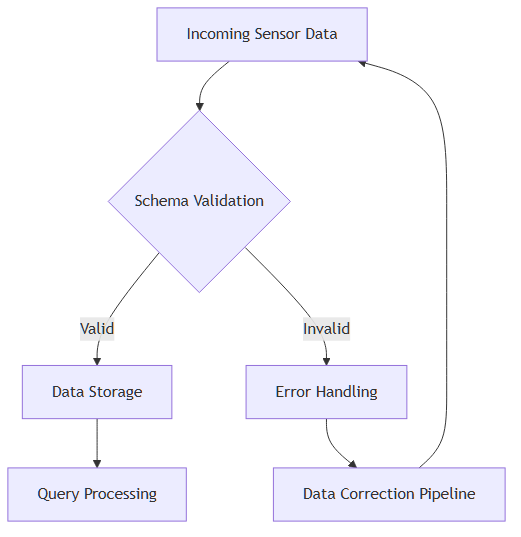
Schema on Write operates on the principle of early validation, where data must conform to a predefined schema before being accepted into the system. This approach contrasts sharply with Schema on Read, where validation occurs during data retrieval rather than ingestion.
The validation process involves several key steps:
Applications in Industrial Systems
Industrial Data Collection
In manufacturing environments, Schema on Write ensures that sensor readings from PLCs, SCADA systems, and IoT devices conform to expected formats. This is crucial for maintaining data quality in systems that monitor equipment performance, environmental conditions, and production metrics.
Process Control Systems
Control systems rely on consistent data formats for real-time decision making. Schema on Write validation prevents malformed data from corrupting control algorithms and ensures that time-series analysis functions receive properly structured inputs.
Compliance and Auditing
Regulatory requirements in industries like pharmaceuticals and aerospace demand strict data governance. Schema on Write provides the necessary validation layer to ensure data meets compliance standards from the moment of collection.
Implementation Considerations
When implementing Schema on Write in industrial systems, engineers should consider:
Performance Trade-offs
Schema on Write optimizes for data quality and consistency at the expense of ingestion flexibility and speed. Key considerations include:
- Write Performance: Additional validation steps increase ingestion latency
- Read Performance: Pre-validated data enables faster query execution
- Storage Efficiency: Consistent schemas allow for better compression and indexing
- Maintenance Overhead: Schema changes require careful coordination across data pipelines
Best Practices for Industrial Applications
Schema on Write represents a foundational approach to data quality management in industrial systems, providing the reliability and consistency required for mission-critical applications while requiring careful consideration of performance and flexibility trade-offs.