Core Fundamentals
Industry 4.0 emerged as a response to the increasing complexity of modern manufacturing requirements and the need for greater operational efficiency. Unlike previous industrial revolutions that focused on mechanization, electrification, and computerization, Industry 4.0 centers on digitalization and intelligent connectivity. The concept originated in Germany's high-tech manufacturing strategy and has since become a global framework for industrial transformation.
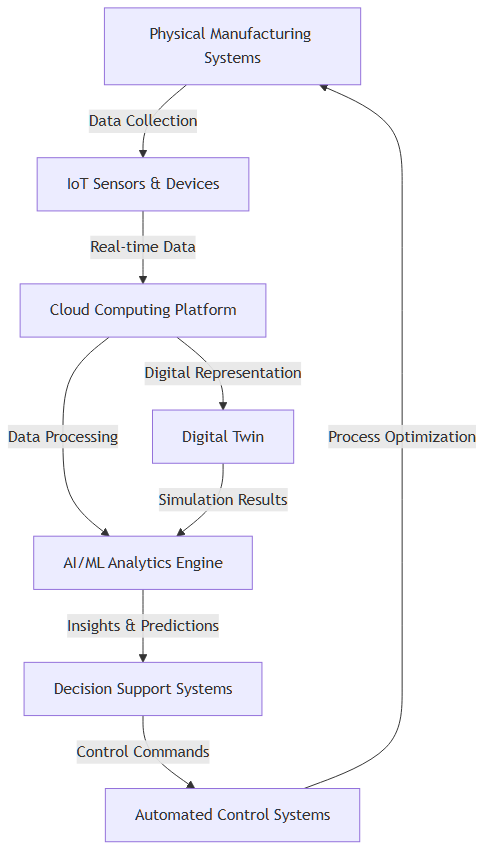
The fundamental premise of Industry 4.0 is the creation of "smart factories" where machines, systems, and humans communicate seamlessly through Internet of Things (IoT) networks. This connectivity enables real-time monitoring, predictive maintenance, and adaptive manufacturing processes that respond dynamically to changing conditions and requirements.
Core Components and Technologies
Industry 4.0 automation relies on several interconnected technological pillars:
Applications and Use Cases
Smart Manufacturing
Industry 4.0 smart manufacturing transforms traditional production lines into adaptive, self-organizing systems. These systems can automatically adjust production parameters, predict equipment failures, and optimize resource allocation based on real-time demand and operational conditions. Smart manufacturing enables mass customization while maintaining the efficiency of mass production.
Predictive Maintenance
Industry 4.0 tools enable sophisticated predictive maintenance strategies that minimize unplanned downtime. By continuously monitoring equipment health through sensors and applying machine learning algorithms, manufacturers can schedule maintenance activities before failures occur, reducing costs and improving operational reliability.
Supply Chain Optimization
Industry 4.0 connectivity extends beyond individual factories to encompass entire supply chains. Real-time visibility into supplier performance, inventory levels, and logistics operations enables dynamic optimization of material flows and production schedules, reducing waste and improving responsiveness to market demands.
Implementation Strategies
Successful Industry 4.0 implementation requires a systematic approach that addresses both technological and organizational challenges:
Pilot Projects: Organizations typically begin with focused pilot implementations in specific production areas or processes. This approach allows for learning and refinement before scaling to broader operations.
Infrastructure Development: Industry 4.0 implementation requires robust digital infrastructure, including high-speed networks, cloud computing resources, and cybersecurity systems. Organizations must invest in upgrading legacy systems and establishing new digital capabilities.
Workforce Development: The transition to Industry 4.0 requires new skills and competencies. Organizations must invest in training programs that prepare workers for roles in digitally-enabled manufacturing environments.
Best Practices and Considerations
Performance Considerations
Industry 4.0 implementation delivers significant performance improvements across multiple dimensions. Organizations typically experience 10-25% increases in operational efficiency, 15-30% reductions in maintenance costs, and 20-50% improvements in time-to-market for new products. However, these benefits require substantial upfront investments in technology, infrastructure, and workforce development.
The return on investment for Industry 4.0 initiatives often materializes over 3-5 years, with early benefits appearing in areas such as energy efficiency, quality improvement, and reduced downtime. Organizations must carefully balance the costs of implementation against expected benefits and maintain realistic timelines for achieving full transformation.
Relationship to Other Concepts
Industry 4.0 serves as an umbrella concept that encompasses numerous related technologies and approaches. Digital transformation provides the broader organizational context for Industry 4.0 initiatives. Lean manufacturing principles complement Industry 4.0 technologies by providing systematic approaches to waste elimination and process optimization.
The concept also intersects with Model Based Systems Engineering through the use of digital twins and simulation technologies. Edge computing supports Industry 4.0 by enabling real-time data processing at the point of operation, reducing latency and improving system responsiveness.
Industry 4.0 represents a fundamental shift in how industrial organizations approach manufacturing, operations, and value creation. By leveraging advanced technologies and connectivity, organizations can achieve unprecedented levels of efficiency, flexibility, and responsiveness. Success in Industry 4.0 implementation requires careful planning, strategic investment, and commitment to continuous learning and adaptation in an rapidly evolving technological landscape.