Understanding High Frequency Sampling Fundamentals
In industrial contexts, high frequency data sampling captures rapid variations in process parameters that would be invisible at conventional sampling rates. Unlike traditional data collection methods that may sample every few seconds or minutes, high frequency sampling operates at rates of 1000 Hz or higher, revealing critical process dynamics essential for Model Based Design and control system optimization.
The fundamental principle involves continuous monitoring of process variables with microsecond-level timestamp precision, enabling detection of transient phenomena, oscillations, and rapid state changes that could indicate equipment malfunction or process instability.
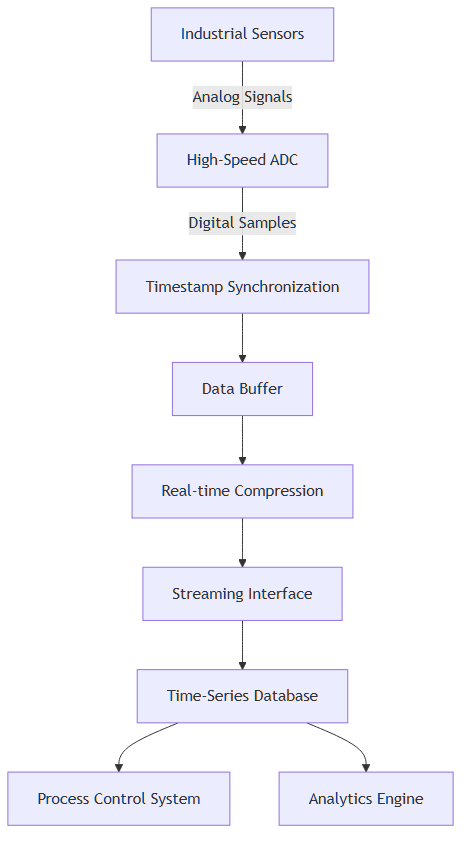
Core Components and Technical Architecture
High frequency data sampling systems require specialized components to handle the demanding requirements:
Applications in Industrial Data Processing
Process Control and Monitoring
High frequency sampling enables detection of process oscillations, control loop instability, and equipment vibrations that indicate maintenance needs. Critical for industries like chemical processing, power generation, and precision manufacturing where process stability directly impacts product quality.
Equipment Condition Monitoring
Machinery health monitoring requires high frequency sampling to detect bearing wear, shaft misalignment, and other mechanical issues through vibration analysis. Early detection prevents catastrophic failures and reduces maintenance costs.
Quality Control Systems
Manufacturing processes with tight quality tolerances require high frequency monitoring to detect deviations immediately. This enables rapid corrective actions and prevents production of defective products.
Performance and Infrastructure Requirements
High frequency data sampling demands substantial infrastructure capabilities:
Data Volume Management: Systems must handle data rates exceeding gigabytes per hour, requiring efficient storage and compression strategies.
Real-time Processing: Processing pipelines must keep pace with incoming data streams while maintaining low latency for control system feedback.
Network Bandwidth: High-speed networks are essential for transmitting large data volumes without introducing delays that could impact control system performance.
Best Practices for Industrial Implementation
Implementation Considerations
# Example configuration for high frequency sampling
sampling_config = {
    'sample_rate': 10000,  # 10 kHz
    'buffer_size': 1000000,  # 1M samples
    'compression': 'lz4',
    'timestamp_precision': 'nanosecond',
    'storage_format': 'parquet'
}
Challenges and Solutions
Data Storage Explosion: High frequency sampling generates massive datasets requiring specialized time-series databases with efficient compression and querying capabilities.
Processing Latency: Real-time processing requirements demand optimized algorithms and hardware acceleration for maintaining system responsiveness.
System Synchronization: Multiple sampling points must maintain precise time synchronization to enable accurate correlation analysis across distributed systems.
Related Concepts
High frequency data sampling intersects closely with sensor data management, telemetry data processing, and Industrial IoT architectures. Understanding these relationships is crucial for designing comprehensive industrial monitoring systems.
High frequency data sampling represents a critical capability for modern industrial systems, enabling unprecedented visibility into process dynamics and supporting advanced control strategies that optimize performance, quality, and operational efficiency.