Understanding Hash Join Fundamentals
The hash join algorithm operates through a two-phase process that optimizes performance for industrial data scenarios involving large datasets. Unlike nested loop joins that can be computationally expensive, hash joins excel when processing high-volume time-series data from industrial sensors and control systems.
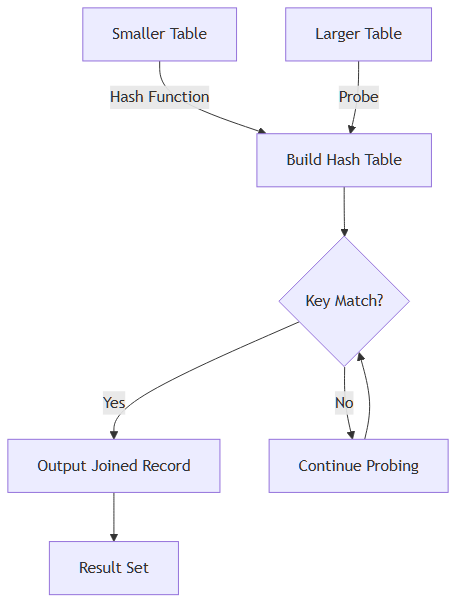
The algorithm works by first building a hash table from the smaller dataset (build phase), then probing this hash table with records from the larger dataset (probe phase). This approach is particularly effective when correlating equipment metadata with streaming sensor measurements or when joining historical process data with real-time operational parameters.
Core Components and Operation
The hash join process consists of four essential components:
Applications in Industrial Data Processing
Equipment Data Correlation
Hash joins are essential for correlating equipment metadata with operational data in manufacturing environments. For example, joining machine specifications with real-time performance metrics to identify equipment operating outside design parameters.
Process Control Analysis
In industrial process control, hash joins enable rapid correlation of setpoint data with actual process measurements, facilitating closed-loop control system analysis and optimization.
Sensor Data Enrichment
Manufacturing facilities generate massive volumes of sensor data that require enrichment with contextual information. Hash joins efficiently combine raw sensor readings with calibration data, unit conversions, and quality metrics.
Performance Considerations
Hash joins deliver optimal performance when the hash table fits entirely in memory, making them ideal for scenarios where equipment metadata tables are joined with larger operational datasets. Memory requirements scale with the size of the smaller table, making proper table ordering crucial for performance.
Key performance factors:
- Memory availability for hash table construction
- Cardinality of join keys and potential hash collisions
- Size ratio between joined tables
- Data distribution patterns in industrial datasets
Best Practices for Industrial Applications
Implementation Example
-- Correlating sensor readings with equipment specificationsSELECT s.timestamp, s.temperature, s.pressure, e.max_temp, e.max_pressureFROM sensor_readings sHASH JOIN equipment_specs eON s.equipment_id = e.equipment_idWHERE s.timestamp >= '2024-01-01'Hash joins represent a cornerstone algorithm for efficient data correlation in industrial environments, enabling real-time analysis of equipment performance and process optimization through rapid data combination capabilities.