Understanding Changepoint Detection
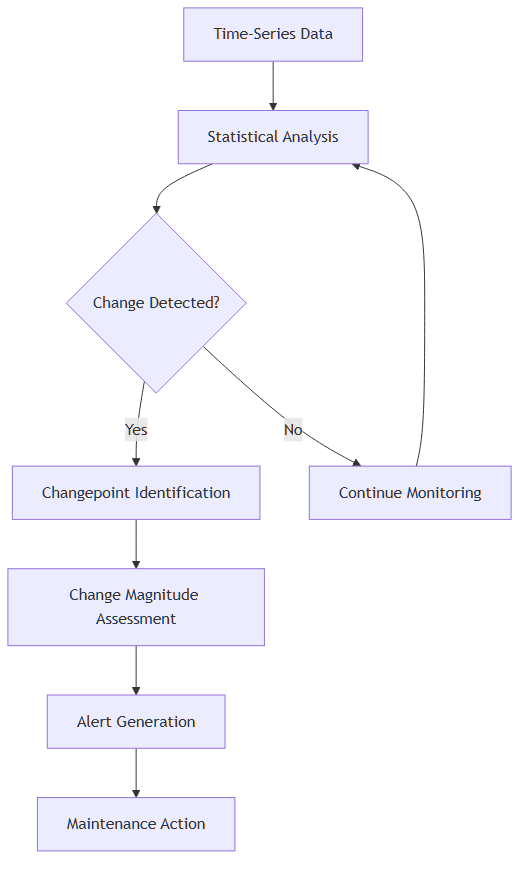
Changepoint detection algorithms analyze time-series data to identify moments when the statistical characteristics of the data stream change significantly. These changes might manifest as shifts in mean values, variance, trend direction, or other statistical properties. Unlike simple threshold-based alerts, changepoint detection uses sophisticated statistical methods to distinguish between normal data variability and genuine process changes.
The fundamental principle involves comparing the statistical properties of data segments before and after potential changepoints. When the statistical difference exceeds a predetermined threshold, the algorithm identifies a changepoint. This approach is particularly valuable in industrial environments where gradual degradation or sudden failure modes need to be detected early for effective maintenance planning.
Core Components and Methodology
Changepoint detection systems typically incorporate several key components:
The detection process can be implemented using various statistical approaches:
- Parametric Methods: Assuming specific probability distributions for the data
- Non-parametric Methods: Making minimal assumptions about data distribution
- Bayesian Approaches: Using prior knowledge to improve detection accuracy
- Machine Learning Methods: Leveraging pattern recognition for complex change detection
Applications and Use Cases
Industrial Equipment Monitoring
Changepoint detection enables proactive maintenance strategies:
- Bearing Condition Monitoring: Detecting changes in vibration patterns that indicate bearing wear or lubrication issues
- Motor Performance Analysis: Identifying changes in electrical signature patterns that suggest motor degradation
- Pump Efficiency Tracking: Detecting performance changes in pump systems through flow rate and pressure analysis
Process Control and Quality Management
In manufacturing environments, changepoint detection supports:
- Product Quality Monitoring: Identifying changes in product dimensions, weight, or other quality parameters
- Process Parameter Optimization: Detecting shifts in process variables that affect production efficiency
- Environmental Condition Tracking: Monitoring changes in temperature, humidity, or other environmental factors
Model Based Design Integration
Changepoint detection enhances MBD workflows by:
- Simulation Validation: Comparing real-world data with simulation predictions to identify model accuracy changes
- Design Parameter Optimization: Detecting when design parameters need adjustment based on operational data
- System Behavior Analysis: Identifying changes in system behavior that require model updates
Implementation Considerations
Algorithm Selection
Performance Optimization
Key considerations for industrial implementation:
- Sensitivity Tuning: Balancing detection accuracy with false alarm rates
- Computational Efficiency: Ensuring real-time performance for continuous monitoring applications
- Data Preprocessing: Implementing appropriate filtering and normalization techniques
- Multi-variate Analysis: Handling multiple sensor inputs simultaneously for comprehensive monitoring
Integration with Industrial Systems
Changepoint detection integrates with various industrial technologies:
- SCADA Systems: Providing real-time change detection for operational data
- Manufacturing Execution Systems: Supporting quality control and process optimization
- Condition Monitoring Systems: Enabling predictive maintenance strategies
Best Practices
Implementation Guidelines
Performance Monitoring
- Detection Latency: Monitor the time delay between actual changes and detection
- False Positive Rate: Track and minimize unnecessary alerts
- Missed Detection Rate: Ensure critical changes are not overlooked
- Computational Load: Maintain efficient processing for real-time applications
Related Concepts
Changepoint detection is closely related to several other analytical techniques:
- Time Series Analysis: The broader field that encompasses changepoint detection
- Statistical Process Control: Traditional quality control methods that complement changepoint detection
- Machine Learning: Advanced techniques for pattern recognition in complex data
Changepoint detection represents a sophisticated approach to industrial data analysis, providing the capability to detect subtle changes that traditional threshold-based methods might miss while maintaining the reliability required for critical industrial applications.