Understanding Changelog Streams
Changelog streams represent an immutable, append-only log of all data modifications that occur within a system. Unlike traditional database snapshots that capture data at specific points in time, changelog streams provide a complete historical record of every change event as it happens, including the type of operation (insert, update, delete), the affected data, and contextual metadata such as timestamps and transaction identifiers.
This continuous streaming approach is particularly valuable in industrial environments where data integrity and traceability are critical for compliance, auditing, and operational decision-making. The stream-based architecture ensures that no data changes are lost and that downstream systems can maintain perfect synchronization with source systems.
Core Components and Architecture
Changelog streams consist of several fundamental components:
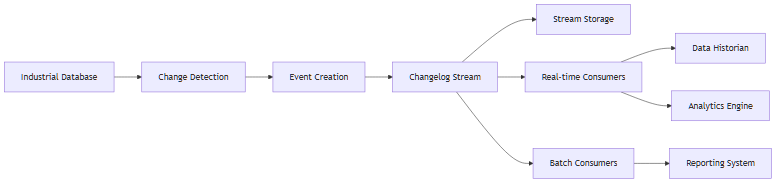
Applications and Use Cases
Industrial Data Synchronization
Changelog streams enable robust data synchronization across industrial systems:
- Equipment Status Tracking: Capturing real-time changes in equipment operational states and propagating them to maintenance management systems
- Process Parameter Monitoring: Streaming changes in process control parameters to quality management and optimization systems
- Inventory Management: Synchronizing inventory level changes across supply chain and production planning systems
Model Based Design Integration
In MBD environments, changelog streams support:
- Simulation Data Provenance: Tracking all changes to simulation parameters and results for complete traceability
- Design Iteration Management: Capturing modifications to design models and propagating them to validation and verification systems
- Configuration Control: Maintaining detailed records of all configuration changes across the design lifecycle
Compliance and Auditing
Changelog streams provide essential capabilities for industrial compliance:
- Regulatory Audit Trails: Maintaining complete, immutable records of all data changes for regulatory compliance
- Quality Traceability: Tracking changes to quality control data and measurements throughout the production process
- Change Impact Analysis: Analyzing the downstream effects of data modifications across interconnected systems
Implementation Considerations
Best Practices
Performance Considerations
Changelog streams must be optimized for high-throughput, low-latency operation:
- Partitioning Strategy: Implement effective partitioning to distribute load across multiple stream processors
- Batch Processing: Configure appropriate batch sizes for change event processing to optimize throughput
- Compression: Use efficient compression algorithms to minimize storage and network overhead
- Consumer Scaling: Design consumer applications to scale horizontally based on stream volume
Integration with Industrial Systems
Changelog streams integrate seamlessly with various industrial technologies:
- SCADA Systems: Streaming operational data changes to enterprise systems
- Manufacturing Execution Systems: Maintaining synchronization between production and planning data
- Predictive Maintenance platforms: Ensuring real-time availability of equipment condition changes
Related Concepts
Changelog streams are closely related to several other data management concepts:
- Change Data Capture: The technology that generates changelog streams
- Event-Driven Architecture: Architectural pattern that relies on changelog streams for event propagation
- Data Streaming: The broader category of technologies that includes changelog streams
Changelog streams represent a foundational technology for modern industrial data management, providing the reliability and traceability required for mission-critical operations while enabling real-time analytics and decision-making.