Using AI to accelerate rotor balancing throughput and reduce capex by 30%
AI can identify difficult rotors before they use extra machine time
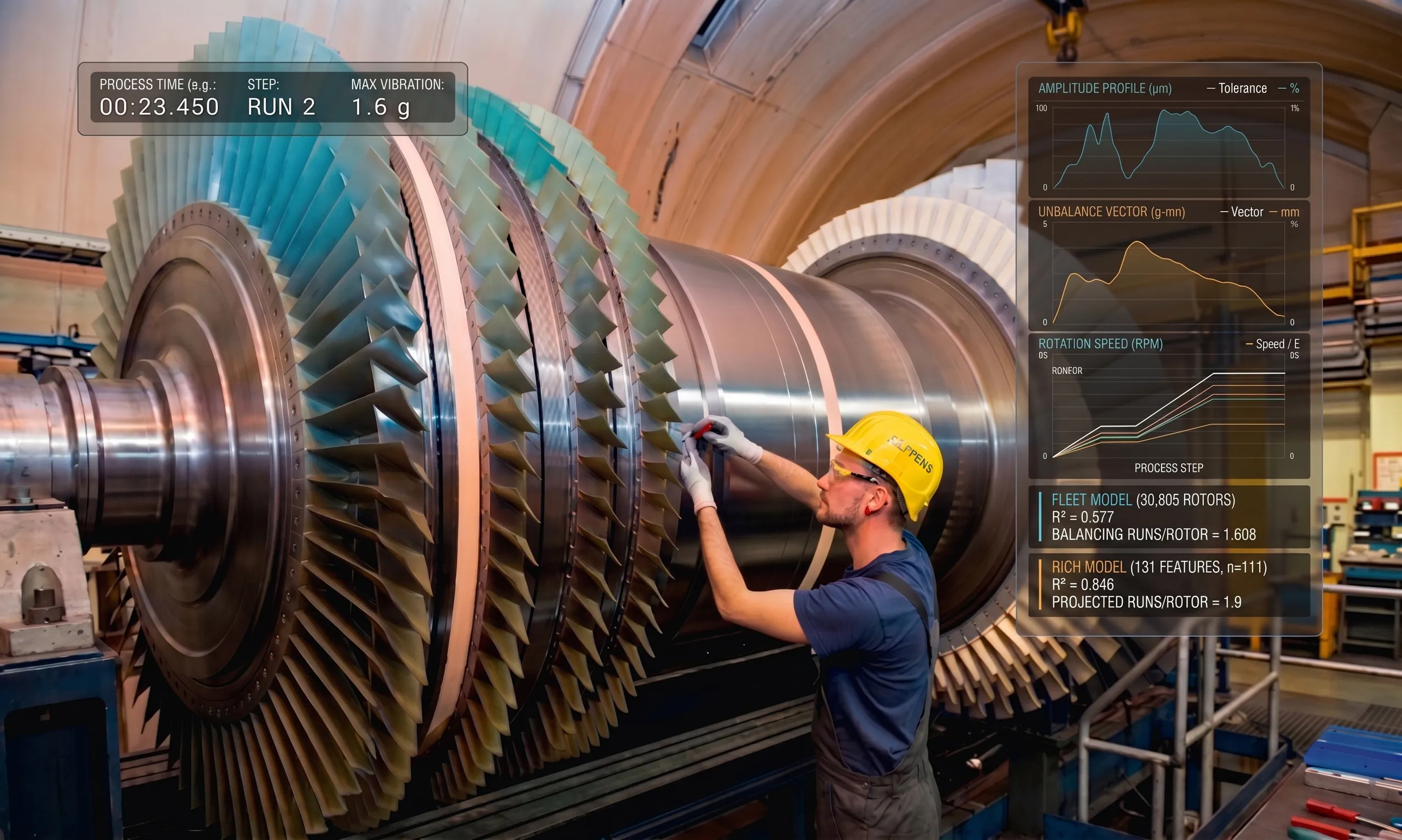
Rotor balancing inefficiencies quietly drain manufacturing capacity across industries. Roughly a third of rotors need five or more balancing runs to clear — and those outliers consume three to five times more machine time than a typical unit, costing manufacturers millions a year.
The problem affects producers of turbochargers, electric motors, aerospace components and automotive driveshafts alike. It stems from balancing machines applying a single calibrated model across an entire rotor family. That works for most units, but it fails for the fraction that respond differently to imbalance — and those are exactly the units that clog the line.
The crucial insight is that the data required to identify those outliers on the first run already exists. Modern balancing machines capture raw vibration signals throughout every run. That signal is rich enough to flag a problematic rotor immediately — but today it stays locked in proprietary formats and is never used.
The three pillars of success
Machine-learning models trained on raw first-run signals can identify problematic rotors before they consume extra machine time — avoiding capital expenditure on additional balancing machines. But the model is the easy part. Infrastructure, not models, determines whether this works in production, and three requirements have to be met.
Data accessibility
Raw sensor data must be queryable in real time, not trapped in proprietary formats. That means the 100 kHz binary streams coming off production machines have to be available the moment a run completes. Nightly exports or manual data pulls aren't a limitation to work around — they're a critical failure of the whole approach.
A knowledge base
Generic classifiers aren't enough. Physics, engineering hypotheses and process history all have to feed into every model interaction. A system that ignores existing engineering knowledge spends its time rediscovering fundamentals the team already understands.
Autonomous execution
The model must be able to write code, execute it against real data, interpret the results and iterate — autonomously investigating whether a specific rotor is an outlier rather than waiting for an engineer to run the analysis by hand.
Bringing the pillars together
Combined, these three pillars create an AI agent with live sensor access, grounded in domain expertise, that can autonomously build and deploy a production solution. That's how a 30% reduction in capital expenditure becomes achievable: not by buying more balancing machines to absorb the outliers, but by catching them on the first run.